Check out my book!

Dust In My Eyes
McClure, Christopher P.
Showing posts with label sustainability. Show all posts

Sunday, September 29, 2019

Parasitism or Responsibility?


Standing on the edge of time I looked and saw a tree
Apart from lesser beings creeping in its shadow
And I noted great stature;
Tall and proud.

I felt small beneath this looming immensity
Yet, it was anchored in one place,
Unable to enjoy that
Which was not present.

Fibrous feet reached deeply into the earth
Over which it towered with arms
Appearing as though
They held the sky

While I merely passed by to other sights and scenes
Remaining not a part, but an observer
Who cultivated,
Who harvested,

Who lived as a scurrying infestation rushing about
Upon the surface, taking sustenance
Rather than building
And anchoring.

It was then I asked if parasitism was my lot or,
Was my purpose much higher than the
Flora which sustained
This place?

The light of awareness lifted me
And I saw within, the responsibility for stewarding
These resources which had been
Provided.

"The Lord God took the man and put him in the Garden of Eden to work it and take care of it." -- Genesis 2:15

Friday, September 27, 2019

Working Grasses


Maintaining a strong stand of grasses is critical to sustainability.  Rotational grazing allows periods of rest that give the grasses time to deepen their roots and to produce seed.  This area of our pasture is primarily Dallisgrass (Paspalum dilatatum) which some folks see as an invasive species.  Our cattle love it.  You do have to be careful because of the potential of a smut infecting the grass which causes problems.

I, of course, chose one of the cleanest, best-looking areas of the pasture for this photograph.  It's too bad all of the pasture doesn't look like this!  The rains this year have been helpful as well.

This pasture has had no fertilizer and no herbicide or, pesticide application since we have owned the place.  The soil here is alluvial and is sometimes covered with silt-laden water that pushes out of the nearby creeks.  The silt is captured by the grasses and the water running off of the land is cleaner than the water that runs onto it!  I wish the folks upstream from me used better management techniques for their land, but then we wouldn't get the benefit of their soil migrating onto ours.

There is a tremendous amount of "carbon capture" in this grass which is then cycled through the cattle.  The Dallisgrass in this meadow will produce 3 to 4 tons of hay per acre each year while maintaining this type of stand, anchoring the soil and capturing all that carbon while it filters the water passing over it.  That's a lot of work!

The meadow also offers food for a number of wildlife species.  Early in the morning, or just before sunset, we often see deer grazing in the meadow.  Our game cameras capture them at all hours of the night as well.  Without the open meadows of healthy grasses, wildlife populations would be significantly diminished.  Deep in a dense forest there is often a lack of food sources for wildlife.  With the variety of both grasslands and forests, the number of food species increases dramatically.  The "edge" where the transition between forest and grassland occurs is crucial to wildlife and frequently where they will be found -- close to food, yet within easy distance to cover.

Now, if we just didn't have the feral hogs that roam the area and tear up the meadow....

Wednesday, September 25, 2019

Food In Balance


There is an area behind our Vet Shed that is not accessible to the cattle and the grass tends to get very lush.  A water hydrant is located there for the occasions when we need to hook up a hose and fill a tank, or whatever.  Late yesterday as I was waiting for my spouse to turn the water on so I could fill a tub, I could hear her talking.  I couldn't make out the words and thought she might have received a call on her cell phone.  Nope, she was talking to this little guy who was hidden in the deep grass.

We have a number of cottontail rabbits that hang out around our place.  I believe this to be an Eastern Cottontail Rabbit (Sylvilagus floridanus).  It is estimated they have an 85% mortality rate prior to reaching maturity -- most of that before ever leaving the nest.  They also are very fertile and have 4 to 5 litters which average about 4 babies each year.  I think their primary role in the environment must be to provide food to predators!

I enjoy seeing the rabbits.  To me, they are an indicator of the health of the land and our local ecosystem.  It is also a joy when the grandchildren spot one.  Their excited voices and happy chatter thrill my heart.

Taking care of the land for future generations is important.  It is something the ranching community does very well.  Usually, there is a multi-generational outlook with a strong desire to see the land passed down to children, grandchildren and more.  Because of that view, ranchers tend to be good stewards and have been practicing sustainable techniques for generations.  Certainly mistakes are made, but subsequent generations apply new knowledge and seek to leave the land in even better shape than that in which it was received.  That is why we see wildlife thrive in areas where ranching is strong.

Just like the rabbits which provide food for carnivores, the cattle are destined to be food.  It is the way the natural system is designed and it is something that many fail to recognize today.  They see the rabbit and think, "what a cute bunny!"  They don't think about the high mortality rates due to it being a food species.  They see a newborn calf and think, "what a cute calf!"  Also, not accepting intellectually that it is destined to be food.  The movement toward an anti-meat society is as destructive of the environment as is the paving of our cities and suburbs.  It doesn't account for the required balance that must occur between plant eaters, meat eaters and carrion eaters.  Our children need to be educated in the realities of a natural system that is one of balance.

Tuesday, September 24, 2019

Cows, Cities, Water and Wildlife


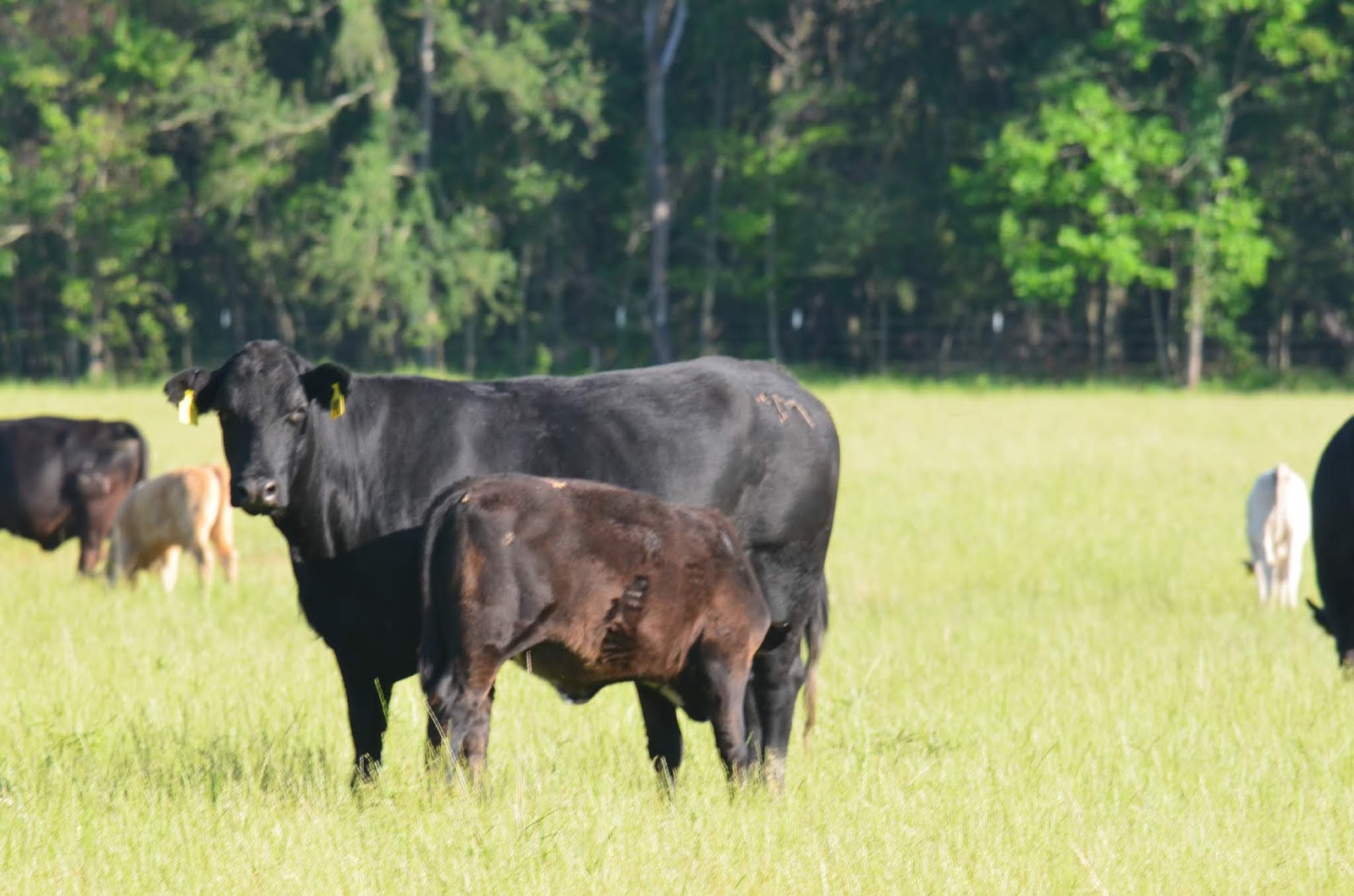
We have a few cows that like to go swimming.  They don't stay in the water very long, but nearly every afternoon at about the same time they walk into the water and hang out for awhile.  This was taken yesterday as we were checking cattle, which we do every day.

When I saw this, my mind overlayed a scene from the movie "Apocalypse Now" when the guy rose up out of the swampy water.  It also made me think of the character John Clark of Tom Clancy novel fame when in "Rainbow Six" he goes into Vietnam on a rescue mission and spends a great deal of time in a similar situation of using the water as cover and then rising up out of it.  Of course, the most obvious mental comparison is to an alligator, or crocodile, sitting motionless in the water with just the top of their head showing as they lurk in hope of unwary prey.

Many people claim that black-hided cattle don't do well in a hot humid environment such as we have in our part of Texas.  You can tell from the photo that this lady is, ahem, well-insulated.  Yes, she takes a dip in the pond to cool off, but she seems to do quite well at maintaining a beyond respectable body weight.  In reality, only about 10% of our cows regularly enter a pond to cool off -- even on the hottest days.  I think that number would be similar for almost any breed of cattle in our climate.

We provide separate, clean drinking water for our cattle.  We have water tanks available that are plumbed to the rural water system so the cattle always have fresh, cool water available to drink.  We also have plenty of areas where there are shade trees deliberately left standing in the pasture in order to provide a place in which the animals can rest.

Those trees also provide roosting and nesting sites for birds.  The ponds provide a home for fish and turtles and a place for wildlife to find water during periods of drought when water is difficult to find.  A lot of people don't realize that many of the water resources for wildlife across the country are there because of cattle ranchers who build the ponds and other small reservoirs to provide water to their stock.  The added benefit is to the wildlife such as waterfowl who are often seen on those stock ponds.

Depending on the time of year, we often see ducks and geese migrating through.  The stock ponds make "safe stops" for those waterfowl -- sort of like a "bed and breakfast" with a meal and place to rest.

 The ponds also help to control erosion.  When there is heavy rain, they provide a "check" to the rushing waters that would eventually eat away the land and leave deep gullies and washes.  Instead, there are grassy waterways which filter the water which goes first into the pond and then as it becomes full, pass over a spillway and continue further down a grass-covered waterway to the next pond.  It prevents the full force of the waters from rushing into streams and rivers and helps to reduce the flooding by slowing runoff.

Flooding is becoming worse because we have so much development with housing and concrete and paved roads.  The water doesn't percolate into the soil, but instead runs off.  On ranch land the story is different as described above.  Not only is the speed of flow reduced, but the water is filtered by the grasses and therefore much cleaner when it enters the streams which often flow into large reservoirs which then are used to provide drinking water to the cities.

Yeah, I'm rambling a bit this morning.  It's a long way from "Apocalypse Now" to city water supplies -- or, maybe not.  I fear that the amount and availability of sufficient drinking water for exploding populations may be the largest single potentially apocalyptic situation we face.  We see flooding in the east and drought in the west.  People are blaming it on climate change yet, we hear lots of rhetoric and hand-wringing and little understanding or, action.  By action, I'm thinking in reference to how cities are growing and spreading and adding to the problems while the ranchers who do the things like controlling erosion and encouraging grasses to cover the ground, which by-the-way also have a cooling effect, are being blamed.  The thinking is absolutely upside down.  That's par for the course, though; it is the people who are exploiting the situation that push the messaging which inspires panic in order to profit from others -- much like "war profiteers" who did the same during the various conflicts that periodically occur around the globe.  I suppose, in a way, that completes the circle from a cow in a pond to "Apocalypse Now."  Well, sort of....

Monday, August 12, 2019

Climate Change Quarterbacks


Some folks are observers
As they pass through this old life;
They prefer the grandstand
With a perch high above
The nitty-gritty going on the field.
Often, they carry on
A running commentary --
A critical analysis of everything they see
But, in which have never participated
As if they were experts
In the field.
They see the execution
Of well-coordinated movement
Which sometimes doesn't
Work as planned
Because there is opposition
Equally bent on succeeding.
Those spectators
See only a small part
Because they had no involvement
In the preparation,
The investment,
The time spent
Honing skills
And developing plans.
They have no
Sweat and blood and tears
Poured into the ground of battle
Yet, they rage on
With blame
When the results on the field
Don't match
The expectations
Of these sideline quarterbacks.

So it is with the beef industry
Which daily fights the battle
Against the elements
To bring food to the table
Of hungry people
Who criticize them
For what they do
More efficiently
And sustainably
Than could have been imagined
By generations
Who have come before
And paved the way.
Climate change?
Look to your steel
And concrete
And luxurious living
As you jet around the world
Burning fossil fuel.

Thursday, August 8, 2019

Stirrup Deep in Grass


Sometimes I just need some wide open spaces.  This photo was taken a few years back while traveling through a portion of the Canadian River country in the Texas Panhandle.  If you click on the picture to enlarge it, you will see cattle scattered in the distance.

It was early Spring, yet you see a good amount of dried grasses among the greening countryside.  This ranch seems to be well managed and supports a large amount of wildlife along with the cattle.  I often see Pronghorn and Mule Deer when I pass through. 

It is an area once covered with American Bison and was a part of what was formerly the Comancheria -- home to the Comanche Indians.  It is one of the last parts of our country that was "domesticated" by settlers.  It was also a haunt of outlaws that raided the north-bound cattle drives during the late 1800's when The Trail shifted west to the eastern edge of the Panhandle.

Although you don't see it in the photo, this is a high-producing area for oil and gas.  In spite of what appears to be land with "nothing" in it, it helps feed the country, fuel the country, provides a home for wildlife and is visually pleasing to this old eye.  I don't think you can get much more sustainable than this.

In my mind I am horseback with my feet just clearing the grass and trailing west....

Wednesday, August 7, 2019

Wind, Cattle and Politics


This is one of my favorite photographs of all time.  I have used it before, although it has been a few years.  It was taken near Vega, Texas, at a wind farm.

I suppose it is a favorite because it shows energy and beef side-by-side on the Texas Plains not far from where I was raised.  Texas has long been known for both, although normally it is oil and gas that comes to mind.  These generators sit on the edge of the Canadian River breaks.  If you could look across the river to the north you would see plenty of the oil and gas production.

It is also a favorite because it shows the two enterprises as being complementary.  The land is being used in a sustainable way for cattle grazing on native pasture while the ever-present wind generates electricity that is sent through the power grid to cities far down state.  The last I checked, Texas still leads the nation in wind-generated power.

Those generators are becoming a problem though.  As time passes, that problem will become even bigger.  What do you do with one when it is broken and no longer can be fixed?  There are quite a few beginning to accumulate around the world.  The proponents of wind energy don't acknowledge the problems with it because it isn't in their backyard -- it's in "flyover" country. 

Food production, energy production, mining/extracting of minerals -- all, for the most part, are in "flyover" country.  The people driving for changes in how these things are done are located on the coasts in their elite enclaves of energy-sucking mansions, dining at high-end restaurants and flying around the world in their private jets.  They dictate policy through their manipulation of the political machinery (which includes the press) but don't have to live with the consequences.  They just enjoy the fruits.

There is always room for improvement, but out here in the country we get a lot of things right.  The wind generators in the photo wouldn't exist without large subsidies extracted from the taxpayers of this nation and passed on to already wealthy individuals who invest in the wind-capturing technology.  What we got right is that it didn't really disrupt the production of protein too much as evidenced by the cattle grazing beneath the generators and it brought a portion of those tax dollars out into the countryside in the form of jobs.

I really didn't intend to bring the political aspects into this brief commentary this morning, but it is a fact of life that the "fat cats" in Washington tend to find ways to make life difficult for the rest of us.  It's all about power and money -- it doesn't matter which political party, they're all essentially the same.

Monday, August 5, 2019

Chickens and Evolving Agriculture


Our neighbor's chickens like to come across to our place on their never-ending hunt for bugs.  They do a great job of reducing the grasshopper population in the area where they forage.  There are multiple varieties of the chickens, but I thought these two Plymouth Rock hens made a great photo because of how they blend into the grass.  When they sit still they are difficult to see.

One of the popular movements around the country is for "free-range" chickens.  These definitely fit the category -- at least the survivors.  They like to roam onto the county road occasionally where they sometimes fall victim to an automobile.  They also sometimes succumb to a less-than-totally-domesticated canine that prowls the area.  I'm sure their nests are visited by skunks and other egg-loving predators -- often there is the faint odor of Mephitis mephitis (striped skunk) drifting gently on the breeze.

Free-range, at least for the chickens, isn't all it's made out to be.

I remember as a small child my grandmother raising chickens.  A couple of them usually fell to her hunting skills and became Sunday Dinner (that's what we called a big family lunch in the country).  She could catch, kill, pluck and clean a chicken faster than you would realize what was going on.  It was part of her persona that you didn't want to mess with her.

Chickens have traditionally been woven into the everyday fabric of farm life.  They once graced the yards and barnyards of nearly every farm in the country.  They were a source of eggs, meat and even feathers to be used in stuffing mattresses and pillows.  They also carried tiny little critters (lice) that sometimes infested the heads of youngsters who played in those same yards and barns.  They helped to control insects and snakes and they served as an alarm clock.

I suppose I became "burned out" on chicken when I was growing up.  It was an inexpensive meat then, just as it is now.  Then, because they foraged on their own and required little expense for maintenance.  Now, chicken is inexpensive due to its rapid and very efficient growth in controlled environments.  Carefully selected genetics and modern production practices have made chicken one of the most pervasive sources of protein available in this country.  It just isn't my protein of choice.

I prefer beef.  When asked if I want chicken for a meal, I sometimes find myself involuntarily commenting, "No, thank you.  That stuff is just fowl." -- the double meaning being clear that "fowl" equates to "foul."  I have a friend who is also in the beef business.  The first time I recall giving him a hard time about ordering chicken in a restaurant rather than steak he informed me he occasionally had to do "competitive meat research."  I have to give him credit for a good comeback.

We are blessed in this country to have abundant supplies of meat -- whether chicken, pork or beef.  Modern production practices make it available at an affordable price to virtually everyone.  Can you imagine what it would be like if every home had to raise its own food?  We sometimes hear, or see, chickens in our community, but they aren't pervasive.  What would it be like if every household had a couple of dozen chickens, a milk cow, a hog pen and maybe even a calf being raised for beef along with an acre, or more, of garden to supply vegetables?  When you think about it, there is no way it works so that a large population can be supported.  Modern agricultural methods are necessary to feed the masses.  The back-to-small-mother-earth methods cannot possibly feed enough people.  The "footprint" would be completely unsustainable.  It would require much more land than is currently employed to produce our food.

I certainly understand the sentiment of those who wish for the "more natural" methods of farming used in days long ago, but the numbers just don't work.  I don't have those numbers in front of me but, I have enough exposure to and experience of those methods to know that they are much more labor intensive, require a larger "footprint" and are far less efficient.  Expense and efficiency are inversely related.  Low efficiency equals greater expense.  If cheap and abundant food is desired to feed the masses, modern agricultural methods are the answer.

Now, are there better ways to do things?  Most likely, yes.  Innovation is needed in many areas of food production, but going backward isn't the answer.

Sunday, July 7, 2019

Feeding the World and Complex Issues


Sometimes the weather cooperates.  The photo above is of a field of grain sorghum (I grew up calling it milo) near Amarillo, Texas, that was taken late last summer.  It is one of the most uniform fields I have ever seen.  If you look closely, there are no signs of disease, or insect damage on the leaves.  The field was planted using minimum-tillage equipment that leaves the remains of the previous crop of wheat stubble intact.  The plant stubble on the field helps to hold moisture in the ground rather than opening it up to evaporation.  The field appears to be weedless as you look across it.

As I view this field I am impressed with what I see.  The crop is extremely uniform.  I recall growing up how there would frequently be odd varieties of plants sticking up here and there in a field of grain sorghum.  The seed in this case must have been very clean with no stray varieties mixed in, or someone spent a lot of time manually removing any that grew.

Fields like this lend themselves easily to automation.  The uniformity is important for utilizing the economies of scale in large equipment that can cover many acres quickly.  The product (grain) will be of the highest quality as long as weather cooperates through the harvest.

This field is also likely home to many hundreds of pheasants.  After the harvest, the birds will be able to easily access seeds that may have fallen to the ground.  The field may also be either grazed by cattle, or the stubble harvested for hay.  Milo butts, if supplemented with protein, can be a good source of energy for cattle.

So, what are the downsides of this type of massive scale agriculture?  One is that the monoculture crop places the entire field at risk to adverse events such as weather, insects, or disease.  Another is that the removal of this much plant material (if the stalks are utilized for hay) means a greater need for the addition of fertilizers.  If grazed, the organic material in the manure adds back to the soil as a rich source of highly available nutrients.

As evidenced by the wheat stubble covering the ground, this crop is part of a rotation system employed by the farmer.  Changing the crop grown on a regular basis helps to mitigate disease and insect risk.

This type of farming requires huge capital investment, but it is highly efficient and part of the reason that U.S. farms are so productive.  In spite of that productivity, due to the capital requirements, the farm is likely only marginally profitable in most years.  It is the result of tremendous scientific advance, although most of that advance is not obvious to the casual observer.

Industrial scale farming is probably not the answer for many parts of the world -- yet.  Perhaps someday.  It is the result of many years of a slow process of advance from subsistence to scale and requires massive amounts of capital to achieve.  As we look at growing populations throughout the world, we need to be cautious about focusing on this single model to resolve the food issues we will face in coming years.  It is my opinion that we should consider a phased approach to move less-advanced agricultural economies by stages into this level of production and we must remain mindful of the social and environmental impacts it will have.

Where the field in this narrative exists was once a prairie ecosystem of short grasses adapted to low rainfall.  The primary large animal was the American Bison.  In a way, what we have described is similar to the way it was 200 years ago -- a field of grass (yes, grain sorghum is a grass) grazed by ungulates.  Today, we add the additional step of harvesting the grain for human consumption.  The natural ecosystem tended to build soil, whereas the current one tends to deplete it.  That is one of the pieces we need to figure out -- how can we have industrial scale agriculture without the need for artificial fertilizers?  Livestock, also utilized for food, may be part of the answer.  They are highly efficient converters of plant material to usable protein.

I've rambled a bit this morning.  The answers to how we produce our food are complex.  Sustainability must include profit in order for there to be advances, but it also must balance the long-term factors such as soil health, resource depletion, capital requirements, labor vs. automation, impact on water and air and myriad other things.  The future of agriculture is bright and attracting some of the best minds to solve these types of issues.  It will be interesting to see the advances just over the horizon.

Saturday, June 15, 2019

Life on the Farm Ain't Really Laid Back....

Sustainability.

S - seeking perpetuity in the ability to deliver.
U - understanding the long-term consequences of actions.
S - securing the welfare of all through thoughtful planning.
T - taking only what is necessary and regenerating where possible.
A - aiming for generational continuity.
I - intelligent use of resources.
N - natural processes that replace damaging practices.
A - acting responsibly toward others and the environment.
B - building systems that focus on renewability.
I - investing in solutions.
L - long-term thinking.
I - integrating economic and environmental systems.
T - teaching responsibility for and to others.
Y - yielding to needs beyond self.

I've been spending time digging into some of the new agricultural technology -- or, at least reading about it.  The buzzword of "sustainability" gets tossed around a lot.  I am a firm believer in sustainability, but I think sometimes the word gets used and abused in ways that subvert the meaning.

Ultimately, sustainability means to look beyond oneself.  All of us follow the natural tendency to focus first on our personal needs and then on the needs of our immediate family.  Rarely, you find those who reach beyond that to their community.  Even more rarely do you see someone who thinks on a broader basis -- to the needs of humanity.  Most of those have some angle that is driving at financial wealth.

We need more people who think in terms of global impact who recognize that we are all -- no matter of race, creed or country -- passengers together on this giant marble swinging around the sun as it hurtles through space.  We need to realize that actions have consequence beyond ourselves.

Am I a globalist?  No.  But, I do believe in a phrase captured in the Declaration of Independence in the words of Thomas Jefferson that "all men are created equal."  In spite of those who would make him an atheist, Jefferson was echoing a Biblical tenet in that we all are descendants of Adam.  We are all part of the human race.  Come to think of it, Darwinians think the same way, but they see us as descendants of primordial ooze.

"Our desire is not that others might be relieved while you are hard pressed, but that there might be equality.  At the present time your plenty will supply what they need, so that in turn their plenty will supply what you need.  Then there will be equality, as it is written: 'He who gathered much did not have too much, and he who gathered little did not have too little.'" -- 2 Corinthians 8:13-15

Feeding mankind will become increasingly challenging as populations continue to grow.  Weather factors affect production in various areas every year.  Seeking ways that work with the local climate, yet recognizing that it won't always cooperate, we must realize that the efforts in one geographic area may ultimately be the salvation of another.  We are dependent on each other -- globally -- for food.  Here in the U.S. many of our fruits and vegetables come from other countries.  They are often luxury foods, rather than our primary foods.  In some other countries that isn't always the case.  Many of them are virtually dependent on imported food to feed themselves.

Profit is necessary in order to fund growth.  It shouldn't be the total focus of man's endeavors, but must be a part of it.  Profit can be defined as "increase" above the cost to produce.  The "increase" of a herd are the calves born.  The "increase" of a crop is that each seed produces many hundreds of seeds.  U.S. food production is profit driven.  In most parts of the world it is survival driven.  We are fortunate to have an economic system that allows us the luxury of building a food system, through its profitability, that surpasses anything in the world.  We must remain aware though, that we cannot feed the world alone and that as our own population grows, there will be increasing pressure on resources by competing needs.

Sustainable practices here can inform sustainable practices worldwide.  We must continue to do more with less.

As to globalism vs. nationalism, I am unashamably a nationalist.  I believe in my country and our system of government.  It is being threatened at a level never before seen -- internally.  Those who would destroy it use everything possible against it -- even food production.  We need to be exporting our beliefs and our systems rather than allowing the destruction of those very things by those who would tear us down in order to build something else.

I suppose I have rambled a bit this morning.  Reading the mess in the news sometimes does that to me....
Google