Check out my book!

Dust In My Eyes
McClure, Christopher P.
Showing posts with label ranching. Show all posts

Saturday, May 2, 2026

 Is It a Weed?

Green Antelope Horn Milkweed (Asclepias viridis) is an important plant for the Monarch Butterfly.  The Monarchs reproduce in the southern U.S. in late summer when the plant is tough.  The problem is that they prefer tender leaves which provide food for the caterpillar stage.

Many ranchers see the Milkweed as just that -- a weed.  It is often targeted along with other weeds that compete with the grasses for grazing.  In many areas, although the Antelope Horn is a perennial, their presence is declining due to the use of herbicides for the control of all non-grass species growing in pastures.

For those ranchers who utilize mechanical means, such as mowing to control pasture weeds, the Antelope Horn and Monarchs can benefit.  Mow in July so that there will be new, fresh growth of the Antelope Horn in August when the Monarchs arrive and are looking for places to reproduce.

Any plant can be considered a weed.  The definition of a weed is any plant growing where it is not wanted.  Competition between plants for limited resources is a critical issue for ranches -- especially during drought conditions.

The way ranchers choose to control weeds is generally an economic decision.  Often, chemical means are the most effective and the most cost effective.  Many weeds are a sign of overgrazing.  They colonize where the grasses have died due to drought and inadequate leaf cover -- not enough left standing.  Without the standing forage, the heat and drought conditions can kill the roots, creating bare areas.  When the rains come, forbs -- weeds mostly -- are the first plants to return.  Reducing weeds allows more grass to be produced.  It is something of a balancing act that requires careful attention to maintain soil health and a healthy balance of the plants growing.  Those factors then determine the level of grazing that can be healthily maintained.

When you add the desire to retain habitat for species such as the Monarch Butterflies, the equation becomes more complex.  Despite the bad reputation they often receive, most ranchers wish to see nature thrive and work to maintain healthy land and pastures.  For those who have areas where the Antelope Horn is established, they can use mechanical means only for weed control while utilizing the more effective chemical means in places that don't contain critical species.  Summer mowing would open the canopy for late season growth while stimulating re-growth of the milkweed prior to the needs of the butterflies.


Thursday, November 21, 2019

The Chant Goes On


Buyers gather around the ring
To hear the auctioneer sing
"Look at these beauties!
Nice young Tiger-Stripe Heifers.
They'll make some dandy cows!
Let's start the bidding."

The chant begins to fill the air
And I look to see who's bidding there
As the Master with the silver tongue
Rolls up the bids I see nary one
With upraised hand
There in the attentive crowd.

Oh, wait, a finger by the nose,
The guy that's wearing farmer clothes,
I'm pretty sure he wants those girls
And over on the other side
I think he might be bidding too,
The one in the bright blue plaid.

He's got his card up by his chin
And taps it every now and then,
That's got to be the way he makes a bid.
Look, there in the back row
By the lady in the in the yellow cap,
I think he might be another one.

Pretty soon we hear, "Sold!"
And those heifers head out in the cold
As we find out that the buyer
Was "Kyle 3X-2"
So, they're headed out west
To wheat pasture for a few months.

"Look at this nice set of light steers!"
The caller chants to calm the fears
That this bunch might just be a wreck
When they get to their destination
Several hundred miles
From where they were born.

"Let's start the bidding...."

Saturday, October 19, 2019

Time Travel


The trail is long,
The days are hot,
The dust chokes,
The sweat soaks,
The bugs bite,
Yet, there is delight
In thudding hoof
And cattle bawls
And clicking horns
And swishing tails
And drifting smells
Of the herd.

Saturday, October 12, 2019

Our Gate Guard


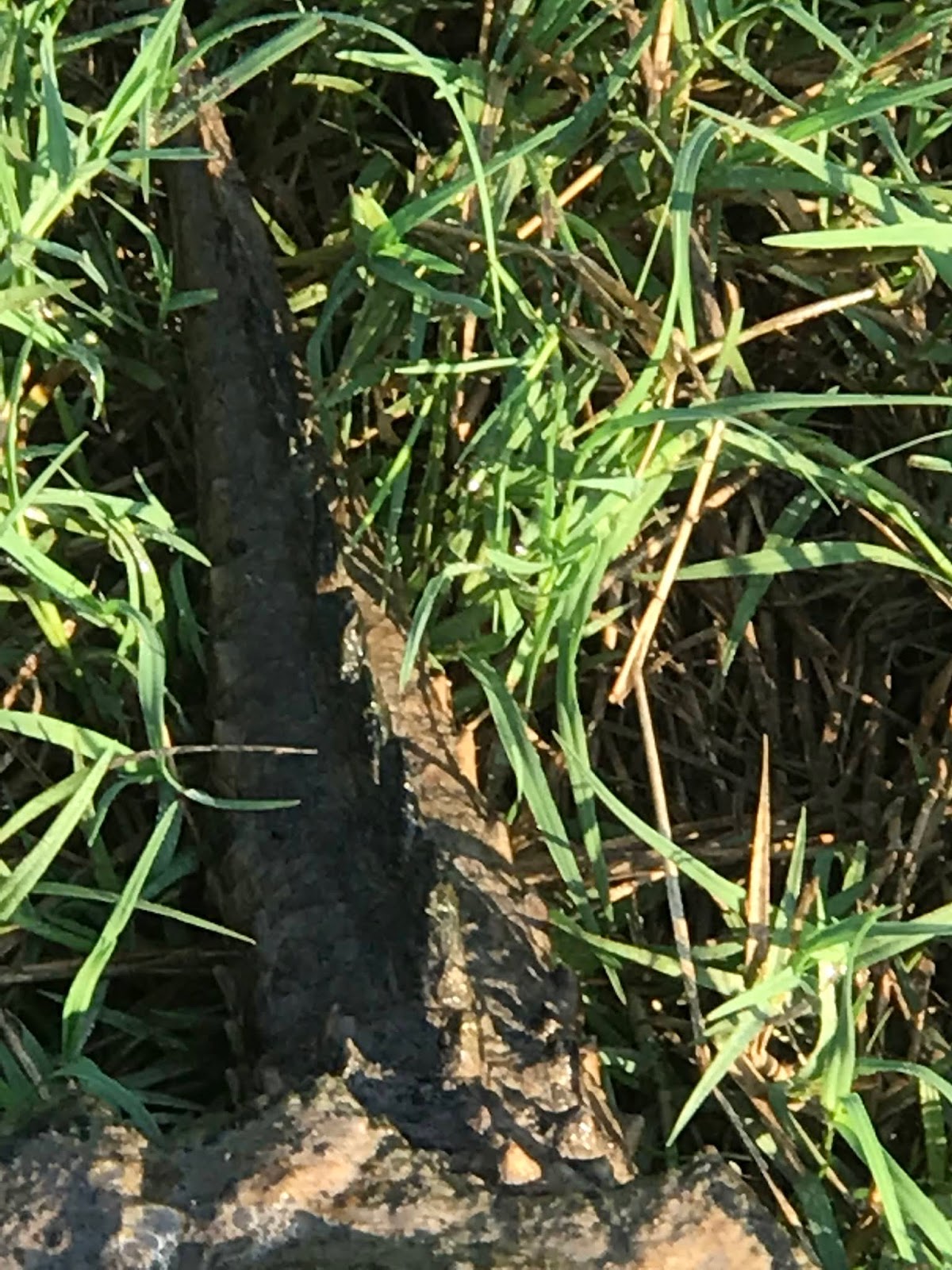
It's kind of hard to make out the details on the uniform our "gate guard" wears, but if you click on the photo and enlarge it, they are quite impressive.  This little guy moved into the latch on our front gate very soon after it was installed.  As you can see by the rust and chipped paint, he has been there for awhile.  I think it is a Bold Jumping Spider, Phidippus audax.  He isn't much bigger than a dime and his aqua-colored eyes probably glow in the dark.

I'm impressed that it has survived as long as it has.  He stays right around the spring-latch on the gate which sees lots of activity.  It's surprising he hasn't been smashed by the latch which is spring activated, or that some human hasn't squashed him.  It could be that he is just too quick for anyone to catch.  I had a hard time getting him to sit still for the photo.

My daughter is not a big fan of spiders.  Arachnophobia is pretty common.  I have to admit that I don't like them crawling on me and I sure hate walking into a web unexpectedly.  Spiders are everywhere.  They are great at thinning the insect populations.

We've let this little one live on our gate for quite some time.  I hope the next owners give him the same consideration....

Wednesday, October 9, 2019

Cows for Sale


When you look across the pasture at a bunch of cattle and then do a double-take because you weren't sure at a glance whether that white one was a calf or one of the bulls, you know it's time to do some shipping.  It is nice to see the big old calves this year.  The one in the photo is in the second weaning group; the first group went to town last month.

The other thing I notice in this photo is the grass.  We are going into the Fall with more grass than we ever had at this time of year.  It has been a good year for growing forage.  Yes, there are a few weeds scattered out there, but not too bad.  If your pasture looks like your lawn you are probably spending too much money on herbicides.  This meadow has had no herbicide applied since we've owned this place.  It also has not been fertilized.  I don't believe it has suffered from lack of either.

This is a bittersweet time for us.  We are selling out.  We are supposed to close next week on the sale of the land.  We have a little time after that in which to disperse equipment and cattle.  If you have any interest in the cows, they are looking for a good home.  The list of equipment is fairly short and I would be happy to provide it to anyone interested.

It's likely this post will prompt a lot of questions among friends and acquaintances.  There is nothing going on except opportunity to pursue new things.  The land and cattle are a joy, but take a lot of time.  We found someone who fell in love with the land much as we did and we came to a mutually satisfactory agreement.

We may buy another place in the country at some point in the future, but for now we are selling out.  Again, we have put together some top genetics in our cows and would love to see them go to a good home that will appreciate their quality.  If you are interested, please contact me.  A Direct Message through Facebook or, Twitter would probably be the best method or, comment on the Blog with your e-mail if you don't already have my number or e-mail.

Saturday, October 5, 2019

Good Help is Hard to Find


A worn out old pickup turned off the highway and crossed the cattle guard into what looked to be a promising spread.  The dust boiled up behind the rusty stock trailer bouncing along behind him on the ranch road as he headed inland toward what looked to be the Headquarters.

As his tires crunched the gravel and he rolled to a stop, the owner stepped out on the porch and waited as the slightly bent door of the old Chevrolet squeaked and popped as it was opened by the lanky visitor who hollered a "Howdy" as he slammed the door and headed toward the house.  It seems he badly needed work and had his horse and tack but, needed room and board and a little something to tuck away for the future.

The rancher eyed him hopefully because help was hard to find and this old cowboy appeared to wear the positive signs of knowing his stuff, but there was always a catch so, he asked the question, "What kind of work are you looking for?"

The grizzled old puncher said, "I been horseback my whole life.  I know cows better than I knew any of my three wives.  Why, I've worked ranches all across the west and can give you plenty of references."

The rancher rubbed his chin and said, "I've got plenty of work and I can supply the room and board and a pretty good wage, but the work will be hard and the days long.  We're spread out over 40 miles and I'm short handed.  You can start in the morning.  The bunkhouse is behind the barn and if you'll get your gear stowed we'll have supper here at the house around six.  You'll find hay in the barn and you can put your horse in the corral out back."

With a grin and a hand shake the old cowboy felt his luck was finally changing.  He pulled his rig around back, unloaded Old Red and hauled his entire life's accumulation of property into the bunkhouse.

Supper was beef and beans with a side of corn bread and the pleasant company of the rancher's wife.  Conversation mostly consisted of the old cowboy sharing tales of his travels around the country and the spreads he had worked.

The next morning, long before daylight, breakfast of pancakes and eggs with bacon and hot coffee greeted the old cowboy who anxiously awaited the day's instructions which the rancher had carefully withheld the night before.  As they walked outside the owner asked, "Do you have a good set of gloves?"

"Yep, I keep a pair of nice, soft calfskin gloves.  I find they're the best for handling a rope or, a hot iron."

The rancher said, "You may want something a little tougher today.  I've got several pair I can supply you.  Here's the keys to that old pickup you saw parked in front of the barn.  If you'll hook it up to that trailer load of cedar posts and meet me back here in about 30 minutes you can follow me up to the north place where I've got about 3 miles of fence that needs built."

The cowboy's face fell as he turned and headed to the barn.  He looked in the back of the old truck and saw the rolls of "devil's rope" stacked there and said a few choice words to himself before pitching the keys in the seat of the old truck.  He then headed to the bunkhouse, grabbed his gear, then loaded Old Red in the rusty trailer.

The rancher heard churning gravel as he came back out to the sight of the worn out old pickup headed back toward the highway, dust boiling.  He shook his head and laughed to himself.  "If that old cowboy knew we were just going to deliver that pickup and trailer to the fencing crew he would have stuck around.  I guess he didn't need work that badly after all."

Friday, October 4, 2019

A Feral Shish Kabob?


This long-legged bug eater was earning his slot in the environment late yesterday.  It has been hanging around our place for awhile.  I was out checking cattle when I spotted him striding deliberately through the grass.  Every few steps his long beak would dart to the ground and capture an insect.  Then, in a lightening-quick motion, the long neck would form an S-shape and with beak pointed upward it would gulp the insect in one swift bite.

The Great Egret, Ardea alba, is a large bird.  They can be almost 4 feet tall and have a wingspan nearing 5 feet.  The only wading bird we see in our area that is larger is the Great Blue Heron.  I was amazed at how this one let me watch him from a distance of less than 40 yards for several minutes before becoming nervous and flying off.

According to a recently released report, North America has lost around 1/4 of its birds in the last 50 years.  I have no doubt this is true, but out in the wide-open spaces where ranching is the primary way-of-life, I see more birds than ever.  In the cities, however, you not only have the paving over of the land, you have millions of feral cats that prey on birds.  I would strongly encourage you to read the linked story.

I think if a feral cat attempted to eat the Great Egret he might become a shish kabob.  Now, that would be an interesting sight!

Wednesday, October 2, 2019

Genetics in Progress


No, they aren't twins, but they look like they could be.  These two look-alike calves are very similar in genetics; the difference is with the maternal grandmothers who were registered Angus.  The mothers had the same Brangus sire and these calves had the same Angus sire.

When I saw them nursing together late yesterday, my mind went back to childhood.  "Mom!  Can Alan stay for supper?"

These two half-sibling Fall-born calves spend all their time together.  They were born on the same day.  Their mothers are half-sisters.  I suppose it was inevitable they would share a meal occasionally.

One of my favorite parts of raising cattle is the young calves.  It is entertaining to watch them grow.  They will sometimes run as if they are racing you across the pasture.  You see them gain confidence and start hanging out with other calves rather than just mom.  You see them start to spend time away from the herd.  Each one is a little different in their behavior, but all of them go through similar processes which slowly lead to weaning and separation from the cow.

Cattle seem to have the process down.  It is genetically programmed into the animals and the environment in which they live determines, to some extent, the way each step occurs.  Humans need to take a lesson from cattle.  When I look around our country I think we, as a country, have lost the art of "weaning" children and of teaching them survival skills.  Sigh.  I'm thankful mine learned enough life skills that they are doing well on their own.

Oh, by-the-way, for those of you not in the cattle business, the breeding system outlined above for these two calves is how you get a uniform cow herd.  You build the uniformity of characteristics on the maternal side by introducing the genetics you need on the paternal side.  It's better to pay a little more for good bulls, or for an AI program, than to live with average genetics.  Fortunately, we started with outstanding genetics and have been tweaking the program ever since in order to adapt specifically to our local environment.  I'm pleased with the results.

Friday, September 27, 2019

Working Grasses


Maintaining a strong stand of grasses is critical to sustainability.  Rotational grazing allows periods of rest that give the grasses time to deepen their roots and to produce seed.  This area of our pasture is primarily Dallisgrass (Paspalum dilatatum) which some folks see as an invasive species.  Our cattle love it.  You do have to be careful because of the potential of a smut infecting the grass which causes problems.

I, of course, chose one of the cleanest, best-looking areas of the pasture for this photograph.  It's too bad all of the pasture doesn't look like this!  The rains this year have been helpful as well.

This pasture has had no fertilizer and no herbicide or, pesticide application since we have owned the place.  The soil here is alluvial and is sometimes covered with silt-laden water that pushes out of the nearby creeks.  The silt is captured by the grasses and the water running off of the land is cleaner than the water that runs onto it!  I wish the folks upstream from me used better management techniques for their land, but then we wouldn't get the benefit of their soil migrating onto ours.

There is a tremendous amount of "carbon capture" in this grass which is then cycled through the cattle.  The Dallisgrass in this meadow will produce 3 to 4 tons of hay per acre each year while maintaining this type of stand, anchoring the soil and capturing all that carbon while it filters the water passing over it.  That's a lot of work!

The meadow also offers food for a number of wildlife species.  Early in the morning, or just before sunset, we often see deer grazing in the meadow.  Our game cameras capture them at all hours of the night as well.  Without the open meadows of healthy grasses, wildlife populations would be significantly diminished.  Deep in a dense forest there is often a lack of food sources for wildlife.  With the variety of both grasslands and forests, the number of food species increases dramatically.  The "edge" where the transition between forest and grassland occurs is crucial to wildlife and frequently where they will be found -- close to food, yet within easy distance to cover.

Now, if we just didn't have the feral hogs that roam the area and tear up the meadow....

Thursday, September 26, 2019

Mud, Pottery and Food Production


Anybody for a facial?  This mud hole is a semi-permanent hog wallow on our place.  It is at a corner on our boundary which jogs around an adjacent creek.  This area has a clay soil on which the water will sit for long periods -- it doesn't percolate into the ground easily.  I suspect the Caddo Indians who once called this area home used this clay in their pottery.

The mud is now being used by hogs and other animals as a place to seek relief from parasites.  A good coating of the sticky mess is protection from biting flies which are a continual nuisance this time of year.  Fortunately, the nature of the soil is such that the damage to the land is limited to this small area, unlike where the hogs dig for grubs and roots in the pasture.

There are many different soils on our place; they range from alluvial deposits from the creeks to heavy clay which underlays the area.  Erosion from past farming practices has left only thin topsoil in a few places with the clay exposed in an area or, two.  Those practices were ended many, many years ago when cotton was no longer a viable economic crop for the farmers.  The land was left fallow or, allowed to go back to pasture and woodland which is the natural mix for this part of the state.

The clay soils interest me because of their use in pottery making.  The most common is a dark gray clay, however, there are also pockets of red and yellow.  The gray seems to be best for pottery based on a few shards that have been found, but I also have seen some pottery made from the red; it seems to have more sand mixed into it and has a grainier texture.

Because of the poor quality of soils in this area, it is difficult to have a high quality garden.  I have not attempted to garden since we have lived here, but would like to do so.  I was visiting with a friend the other day and we were standing at the end of his very large Fall garden which was pumpkins and black-eyed peas.  I bent down and grabbed a handful of soil and worked it in my hand.  It seemed almost ideal for raising crops.

I asked him about it and he said it has taken a lot of years to get it that way.  He has hauled in sand, peat and composted manure to get it to the consistency that it now has.  He uses a roto-tiller to work the soil and always turns the plant residue back into the soil.  His flock of chickens were working hard to remove any bugs they could find among the young plants as we visited.  He had planted some older varieties of peas and we talked some about heirloom plant species.

Once again, I have taken a wandering path in my post.  What I want to convey is that ranchers and farmers care about the land.  When working within a natural system there are many areas of knowledge that require attention.  Today, there are many who want to move away from traditional agriculture.  I have posted previously about skyscraper greenhouses clinging to the sides of a building and about the use of robotics and artificial intelligence.  Those things have a place, but I hope we never lose the general understanding of how to grow our food utilizing the resources within a natural system.

The Caddo Indians understood the land.  They raised crops, hunted wildlife and were able to find all they needed for survival as provided by nature.  They cooked their meals in pots made by their own hands from the soil that supported the wildlife and plants that went into it.  I fear much of that knowledge is disappearing in our technology-focused world. 

Wednesday, September 25, 2019

Food In Balance


There is an area behind our Vet Shed that is not accessible to the cattle and the grass tends to get very lush.  A water hydrant is located there for the occasions when we need to hook up a hose and fill a tank, or whatever.  Late yesterday as I was waiting for my spouse to turn the water on so I could fill a tub, I could hear her talking.  I couldn't make out the words and thought she might have received a call on her cell phone.  Nope, she was talking to this little guy who was hidden in the deep grass.

We have a number of cottontail rabbits that hang out around our place.  I believe this to be an Eastern Cottontail Rabbit (Sylvilagus floridanus).  It is estimated they have an 85% mortality rate prior to reaching maturity -- most of that before ever leaving the nest.  They also are very fertile and have 4 to 5 litters which average about 4 babies each year.  I think their primary role in the environment must be to provide food to predators!

I enjoy seeing the rabbits.  To me, they are an indicator of the health of the land and our local ecosystem.  It is also a joy when the grandchildren spot one.  Their excited voices and happy chatter thrill my heart.

Taking care of the land for future generations is important.  It is something the ranching community does very well.  Usually, there is a multi-generational outlook with a strong desire to see the land passed down to children, grandchildren and more.  Because of that view, ranchers tend to be good stewards and have been practicing sustainable techniques for generations.  Certainly mistakes are made, but subsequent generations apply new knowledge and seek to leave the land in even better shape than that in which it was received.  That is why we see wildlife thrive in areas where ranching is strong.

Just like the rabbits which provide food for carnivores, the cattle are destined to be food.  It is the way the natural system is designed and it is something that many fail to recognize today.  They see the rabbit and think, "what a cute bunny!"  They don't think about the high mortality rates due to it being a food species.  They see a newborn calf and think, "what a cute calf!"  Also, not accepting intellectually that it is destined to be food.  The movement toward an anti-meat society is as destructive of the environment as is the paving of our cities and suburbs.  It doesn't account for the required balance that must occur between plant eaters, meat eaters and carrion eaters.  Our children need to be educated in the realities of a natural system that is one of balance.

Tuesday, September 24, 2019

Cows, Cities, Water and Wildlife


We have a few cows that like to go swimming.  They don't stay in the water very long, but nearly every afternoon at about the same time they walk into the water and hang out for awhile.  This was taken yesterday as we were checking cattle, which we do every day.

When I saw this, my mind overlayed a scene from the movie "Apocalypse Now" when the guy rose up out of the swampy water.  It also made me think of the character John Clark of Tom Clancy novel fame when in "Rainbow Six" he goes into Vietnam on a rescue mission and spends a great deal of time in a similar situation of using the water as cover and then rising up out of it.  Of course, the most obvious mental comparison is to an alligator, or crocodile, sitting motionless in the water with just the top of their head showing as they lurk in hope of unwary prey.

Many people claim that black-hided cattle don't do well in a hot humid environment such as we have in our part of Texas.  You can tell from the photo that this lady is, ahem, well-insulated.  Yes, she takes a dip in the pond to cool off, but she seems to do quite well at maintaining a beyond respectable body weight.  In reality, only about 10% of our cows regularly enter a pond to cool off -- even on the hottest days.  I think that number would be similar for almost any breed of cattle in our climate.

We provide separate, clean drinking water for our cattle.  We have water tanks available that are plumbed to the rural water system so the cattle always have fresh, cool water available to drink.  We also have plenty of areas where there are shade trees deliberately left standing in the pasture in order to provide a place in which the animals can rest.

Those trees also provide roosting and nesting sites for birds.  The ponds provide a home for fish and turtles and a place for wildlife to find water during periods of drought when water is difficult to find.  A lot of people don't realize that many of the water resources for wildlife across the country are there because of cattle ranchers who build the ponds and other small reservoirs to provide water to their stock.  The added benefit is to the wildlife such as waterfowl who are often seen on those stock ponds.

Depending on the time of year, we often see ducks and geese migrating through.  The stock ponds make "safe stops" for those waterfowl -- sort of like a "bed and breakfast" with a meal and place to rest.

 The ponds also help to control erosion.  When there is heavy rain, they provide a "check" to the rushing waters that would eventually eat away the land and leave deep gullies and washes.  Instead, there are grassy waterways which filter the water which goes first into the pond and then as it becomes full, pass over a spillway and continue further down a grass-covered waterway to the next pond.  It prevents the full force of the waters from rushing into streams and rivers and helps to reduce the flooding by slowing runoff.

Flooding is becoming worse because we have so much development with housing and concrete and paved roads.  The water doesn't percolate into the soil, but instead runs off.  On ranch land the story is different as described above.  Not only is the speed of flow reduced, but the water is filtered by the grasses and therefore much cleaner when it enters the streams which often flow into large reservoirs which then are used to provide drinking water to the cities.

Yeah, I'm rambling a bit this morning.  It's a long way from "Apocalypse Now" to city water supplies -- or, maybe not.  I fear that the amount and availability of sufficient drinking water for exploding populations may be the largest single potentially apocalyptic situation we face.  We see flooding in the east and drought in the west.  People are blaming it on climate change yet, we hear lots of rhetoric and hand-wringing and little understanding or, action.  By action, I'm thinking in reference to how cities are growing and spreading and adding to the problems while the ranchers who do the things like controlling erosion and encouraging grasses to cover the ground, which by-the-way also have a cooling effect, are being blamed.  The thinking is absolutely upside down.  That's par for the course, though; it is the people who are exploiting the situation that push the messaging which inspires panic in order to profit from others -- much like "war profiteers" who did the same during the various conflicts that periodically occur around the globe.  I suppose, in a way, that completes the circle from a cow in a pond to "Apocalypse Now."  Well, sort of....

Friday, September 20, 2019

Sometimes We Need Help


Animals, just like humans, sometimes get sick.  This little guy is an orphan.  We don't know what happened to his mother, but one day she seemed perfectly healthy and the next day she was gone.  This young (about 6 week old) bull calf was "stealing" milk from the other cows that had calves at their side and had started eating grass.  We watched him closely for a few days and he seemed to be doing okay, but then on Monday of this week I spotted him off by himself and showing signs of respiratory distress.  I immediately got out of the pickup and herded him to the corrals on foot.  The fact that I could do so was an indicator that he didn't feel well.

We began to treat him for the respiratory problem and to hand feed him.  He was going downhill, so on Wednesday we took him to the Veterinarian.  She has access to more powerful tools than we do and by Wednesday evening he was feeling much better.  The photo is from late yesterday when he nearly knocked me down to get the bottle.  It was gratifying to see that he seemed to feel much better and signs of the respiratory issue were gone.

Unlike humans, animals are unable to ask for help when they are in distress.  In fact, animals such as cattle are naturally wary of giving any indication that they don't feel well because they are naturally prey animals.  It is the sick and distressed that are usually first to fall to predators.  I have observed sick cattle "put on an act" of feeling well and "pretending" to eat in order to appear healthy.  Sometimes it is very difficult to spot a health problem until the animal is extremely sick and difficult to heal.

As I have mentioned before in this blog, we feel a deep responsibility to the animals within our care.  We monitor them daily in order to make certain they have adequate food and water and that they are healthy.  Occasionally, something will happen to one of them that is inexplicable -- such as the loss of this calf's mother -- but, for the most part, we are able to catch any problems early and to deal with them expeditiously.  It is important that we have the tools to do so in order to prevent undue suffering.

The movement to ban the use of antibiotics in livestock production is one that threatens our ability to deal with issues, such as the respiratory problems this calf had, in a timely fashion.  The medicines with which he was treated will be completely metabolized and gone from his system within a matter of a few short weeks.  The labels include withdrawal times and dosages which we record and keep, along with other information about the event, in a file if an animal must be treated.  Hopefully, this calf will be able to go on and live out a normal, healthy life in which he will thrive until he fulfills his ultimate purpose of providing nutritious protein for human consumption.

As I think about it, I realize that the inability to ask for help sometimes applies to humans as well.  In us, it isn't so much that we are incapable, it is that our pride or, our personality make it extremely difficult.  We also are influenced by the way in which we were raised -- especially in rural America where independence and self-reliance are deeply rooted in the culture.  For some reason this morning, I feel it is important to say that it is okay to ask for help.  Don't be like the calf in the photo who would have died in his loneliness had I not observed his condition and intervened.  If you need help, ask for it.  Ask friends, neighbors, family, or one of the many organizations that are out there for help.  There are good people who will be there for you if they know you need it.

Just my thoughts this morning....

Thursday, September 19, 2019

Working Together for Conservation


Sometimes as I am searching through photographs for an image to use in a post I come across one that makes me think of something completely unconnected to the particular picture I am viewing.  This is one of those images.  It was taken on our place last November.  I remember it being one of those perfect Fall days and I decided to take a walk.

It was the kind of day that deer hunters love.  I wasn't hunting, just walking and looking.  When I see this photograph, though, I think of quail hunting.  I miss quail hunting.

When I was growing up I always looked forward to the Fall because it was quail hunting season.  We had a number of places on which we were allowed to hunt.  My father was an avid hunter and very enthusiastic about the sport.  I walked many miles alongside him in pursuit of an exploding covey.

My memories of quail hunting include the slight scent of dust from the dry grasses filling my nostrils.  In my mind I can hear the crunch of frosty forage beneath my feet and the swish of the tall plants against my clothes.  I can smell the light oil on the shotgun and the slightly sulfurous whiff from a spent shot.  Most of all, I remember the feel of the tingling nerves in anticipation of the flushing covey coming up, first in ones and twos, then in a sudden rush that filled the air with buzzing wings as the birds raced away.

The quail populations have suffered a general decline over much of the state.  There are very few coveys left in this area.  To me, the photo above represents ideal habitat that needs quail.

Fortunately, state game biologists and ranchers have been working together to help remaining populations recover from whatever caused the decline.  I have heard many theories, but I'm not certain there is a consensus on the cause(s).  On the positive side, however, is the fact that private land owners have worked closely with universities and with state agencies to aid in the recovery.  That's something the public doesn't hear much about -- the private-academic-governmental cooperation.

It makes you proud of your community when you think about it.  I appreciate those ranchers' willingness to work to conserve this precious resource.

Wednesday, September 18, 2019

Living to the Next Paycheck


Today is sale day for this group of calves.  They will be sold in the NETBIO (Northeast Texas Beef Improvement) sale.  It is a special sale of pre-conditioned, weaned calves that are certified to have been properly vaccinated and taught to eat from a feed bunk and automatic water system.

I'm proud of this group.  We have been working for a number of years to get our genetics to where we wanted them.  This is a very uniform set that will hopefully do well in spite of a market that has been disappointing recently.

One of the things people outside of agriculture have difficulty grasping is that "harvest" only comes once or twice during the year.  To put it plainly, there is no income, only expenses, for the greatest part of the year.  Selling your crop has to pay all of the expenses required to produce it and provide an income above that to the farmer or, rancher.  It is just a "side gig" for us, so we aren't dependent upon it for our living expenses.

Most people can't imagine living on borrowed money for 11 months of the year and then hopefully, paying it back when you sell your crop.  It makes a person better at budgeting.

Right now, as we enter into the Fall Harvest season, keep the farmers and ranchers in mind.  For many, it has been a very difficult year with flooding, drought, severe storms that brought hail and high winds and it has been a year of "Tariff Wars" that have been highly disruptive of the markets.  Many of the farmers and ranchers won't be able to cover their expenses of producing a crop this year let alone covering their cost of living.

As you enjoy your abundant selection of foods at the grocery store, or in your favorite restaurant, think about the folks that produced it.   They're going through a hard time right now.

Tuesday, September 17, 2019

Treating Ignorance (lack of knowledge)


Raising cattle requires controlling parasites.  There are many that attack the animals both internally and externally.  The large, flying critter you see in this photo is a horse fly resting upon the back of one of our calves.  If you look more closely, to put it in perspective, you will see a number of horn flies toward the edges of the photo.  There is quite a difference in their size.  Both are irritants to the cattle.

The horse flies are a source of the organism that causes Anaplasmosis.  They carry tiny rickettsial parasites called Anaplasma marginale or Anaplasma centrale which cause severe anemia.  The parasites can also be carried by ticks, but in our area, the horse flies seem to be the primary vector.  Fortunately, it is easily treatable with tetracycline.  Without treatment an animal -- especially mature ones -- will usually die within a matter of a few weeks.

The movement by many toward livestock production without the use of chemicals or, antibiotics is one based in ignorance.  No rancher uses such things unless they are necessary to protect their animals from disease and possibly death.  All products available for use on animals have been tested and the rates at which they disappear from being present in the blood, or tissue of the animal through normal metabolic processes has been determined.  This provides for a known withdrawal date on any products that are used.  Most are completely gone from the animal within a very short time.  Animals can't be harvested for meat if there is any residue and are tested at the harvest facility for such.

One of the arguments against the use of antibiotics in animals is that it causes organisms to become resistant and therefore the treatment becomes less effective over time.  There is certainly some validity to the point, however, the majority of organisms that are treated are species specific and not zoonotic.  Zoonosis is the transfer of pathogens between species -- such as tuberculosis -- but the list of such diseases is fairly short and when they occur in livestock they are reported to the state Animal Health Commission and steps are taken to isolate any infected animals and prevent the spread.

I use fly spray to help control the pesky horse flies and horn flies which attack my cattle.  I've used the same sprays in my kitchen!  It seems beyond cruel to me to allow the flies to constantly attack the cattle and potentially make them sick through the parasites they carry.  The female horse flies have strong cutting mandibles which they use to slice open the skin.  They then will sit and drink the blood from the seeping wound.  As they do so, the parasites they carry within their saliva enter the wound and the blood stream of the animal and present the risk of disease.  If the cattle show signs of sickness I immediately treat them with an antibiotic targeted at the disease.

If you are one who is on the bandwagon of the crusaders who wish to ban the use of such products in livestock, please take a minute to consider the cruelty that will be inflicted on those animals.  Today we are able to produce a safe and wholesome product because those tools are available.  Without them, a lot of animals would die a slow death from disease.

I suppose this seems like a morbid subject early in the morning.  It is on my mind because I am about to head out to doctor a sick calf.  Those animals are my responsibility as long as they are in my care.  I will do my best to raise them in a manner that respects them and provides the best environment in which they can thrive.

Friday, September 13, 2019

Sometimes You Have to Dig for the Reason


It being Friday the 13th with a Full Moon, I thought it only appropriate that I use the photo of a 4-leaf clover in my post, however, I have committed to only use original photos and not something "borrowed" from the Internet and I didn't have one of a 4-leaf clover.  Instead, I will use this Brazos Rain-lily (Zephyranthes chlorosolen) as a substitute.  We had a number of them make their appearance in our pasture after the rain we had a couple of weeks ago.  They aren't large -- about 12" tall consisting of a single stem shooting up out of the ground with a flower approximately 2" in diameter.

To the extent possible, we try to identify the plants we find growing in our pastures.  Some plants are toxic to cattle and we especially watch out for them.  Such plants typically only appear sporadically such as after a drought or, in a particularly rainy stretch at a time of year when it doesn't normally rain as much.  Knowing the flora and fauna on the land within your care is important for that reason, but also for others.

There are numerous rare or, endangered species of plants and animals.  When you speak of such things, most ranchers cringe because of the bad experiences of some where their land was restricted in its use due to the presence of such items.  Various government agencies have a good deal of power to do such and so, most occurrences of threatened plants and animals go unreported due to fear, or to willful ignorance.  I fully sympathize with that.  No one wants how they utilize their land to be restricted due to the presence of some rare salamander, or minnow, or weed.

It is difficult, even for someone who is very much a conservationist at heart, to reconcile the preservation of every single species against the rights and needs of individuals.  I am a firm believer that "less government" is the best government.  Personal property rights are one of the most important foundations of our liberty; without them, there is no free enterprise and very little incentive to grow and create.

A willingness by many to restrict such rights is typically due to a jealousy of the "have nots" toward those who have been able to acquire substantial property.  Is the system rigged?  You bet it is.  Those who have accumulated property have considerably more power than those who haven't.  That is why there is a need for appropriate regulation of the rights of ownership that weigh the needs of the many against the "rights" of the individual.  It is why we have labor laws and regulations against certain monopolistic practices.

When it comes to things of a more esoteric nature -- such as rare plants and animals -- it is sometimes difficult to determine where the needs/rights of the individual end and public needs/rights begin.  I don't pretend to have deep specialized knowledge regarding such issues, but in general, I understand the concept that we need to maintain biodiversity.  Even the most well-trained scientists only understand the "surface" of the intricate workings of various ecosystems.  Each time a species goes extinct, there is the danger of a cascading effect that can cause widespread disruption.  There also is the potential commercial/social value that many plants and animals offer as food or, as sources of medicines and other potentially important compounds.  In summation, we don't know enough to know what we don't know, therefore the wise course is to preserve.

Fortunately for me, the Lily in the photo is not an endangered or, threatened species.  It does however, produce an alkaloid called lycorine, a fungicide, which protects the plant against Phymatotrichum root rot.  That characteristic alone could make it valuable given gene splicing technology such as CRISPR.  The genes from the Brazos rain-lily that cause it to produce the lycorine might could be spliced into the DNA of a cotton plant for instance, giving it the ability to resist root rot in times of too much rain.

Maybe there is a reason to protect those plants and animals after all....

Friday, September 6, 2019

Planning for Adjustments to the Plan


This is a photo of our first "official" Fall calf.  It's a long story but, we have a small group of cattle that are set up for Fall calving instead of Spring.  Rather than go into why we now have two different calving seasons, suffice it to say that sometimes the best way forward is to adjust your game plan and keep moving!

I was pleased to see this calf.  His mother had a Brangus Sire and Angus Dam.  This little heifer's daddy is Angus.  There are genetics for both low birth-weight and growth throughout the pedigree.  I am excited to see how this little heifer will perform.  If things work out, she will become part of the cow herd in the future.

Plans need to have room to accommodate change.  I have yet to see a plan that didn't require adjustment -- sometimes radical adjustment -- to deal with completely unexpected circumstances.  Do you plan to have to change your plan?

If you have read much in the way of science fiction, or perhaps watched a few science fiction movies, you have run across the concept of "multiple futures" or, "split" time lines.  Basically, depending on what happens at critical points determines which "branch" of the future will become reality for you.  Choices determine the path you will continue to move upon.  When planning, we need to recognize those points where we are likely to be forced to make choices depending on what occurs.

When we develop plans, I think it is wise to include something like a decision tree.  Essentially, it recognizes to the extent possible, those nexus points where events are likely to occur which could dramatically affect our plan.  In a breeding program it might be that you suddenly find yourself with a large number of open cows.  It forces a choice.  You can liquidate that part of the cow herd, or you can move them to a different calving window.  You also must diagnose what caused the large number of open cows.  If it was a disease event, you take steps to prevent it in the future.  If it was an infertile bull, you replace the bull.  The point is, if you prepare ahead of time by, at minimum, thinking through the potential issues and responses, it is much easier to make a timely adjustment and continue moving forward.  You have time to look at the numbers and the potential long-term impact of each possible path rather than making a snap decision.

We can never plan for all of the things that might occur, but we can prepare for many things that might, or might not happen.  It is much different than worrying.  We tend to worry about things we can't control, we plan for things that we can.

I have always preferred to focus on offense rather than defense.  Planning is offense in nature -- even if you are planning how to defend against possible difficulties.  It is taking initiative rather than passively waiting for things to happen.  I have worked with people in the past that continually worried about what the competition was doing.  My response was that we can't build our program around someone else's game plan and expect to be successful.  We need to focus on our game and performing to the best of our ability.  If we are constantly reacting to the "other guy" we will never accomplish our own goals.

Life will always throw challenges your way.  Plan ahead, prepare for the likelihood that it won't work the way you hope, but always, always focus on your game and not everyone else's.  Just keep on executing to the best of your ability and good things will happen -- like that beautiful black calf in the picture.

Tuesday, September 3, 2019

A "Snappy" Traveler


Yesterday as I was out checking cattle I came across this old boy making his way across the pasture.  We had good rains a few days ago and there is lots of water so, he wasn't far from the next pool.  I'm sure he was out exploring, shopping for a new neighborhood.  This is a Common Snapping Turtle (Chelydra serpentina).  They are found pretty much everywhere east of the Rocky Mountains.  This one probably weighed around 12-15 lbs but they can get much larger.

He was fairly calm as I moved around him taking his photograph -- almost as if he was posing.  He was obviously wary, but I suspect he was "King" of the last waterhole in which he lived and felt like he could take on anyone or, anything. 

When I was a kid we sometimes would get to go fishing in a farm pond on one of several places near where my Dad was raised.  There were lots of turtles, including this bad boy's bigger cousin, the Alligator Snapping Turtle.  They could be vicious.  They showed little fear either and would open their vice-like jaws wide while hissing at you.  They put plenty of fear in this kid who was told if one bit me they wouldn't let go until it thundered.

When I look at the photos I am reminded of the creatures in Jurassic Park the movie and its sequels.  The Snapping Turtle truly looks like a dinosaur with its protective shell and spiny tail.  Just imagine a larger version of it coming after you.

Turtle eggs were a prized source of food for many of the tribes native to the southeastern United States.  The adults were the primary ingredient in turtle soup.  They are not threatened or, endangered but, if you like turtle soup, be aware that since they often inhabit stagnant pools and will eat virtually anything -- plant or, animal -- they tend to concentrate any toxins that may be in the water and eating too much turtle might not be a particularly healthy endeavor for that reason.

As any of you who read this Blog on a regular basis have probably figured out by now, I enjoy the outdoors and the wild plants and animals found there.  Unlike many who think agriculture and wild places can't co-exist, I believe they are complementary.  We need to re-think some farming practices such as mono-cropping, but for the most part, nature is resilient and when we do things correctly in food production, wildlife abounds alongside our domesticated animals.  The grass you see that turtle making his way across is food for the cattle and also acts as a filter for the water running into a nearby creek.  The runoff from this pasture is virtually clear water whereas forested areas nearby, which have little ground cover, produce muddied water full of soil and debris.  Ranching is good for the land if for no other reason than that cover of grass which cleans and purifies the water before it goes into the reservoirs from which we obtain our drinking water.  Besides, who wouldn't prefer a steak to turtle soup?

Friday, August 30, 2019

Big Tracks


No matter where you go in this old world, people have been there ahead of you.  I think that's why history appeals to me as much as it does -- I want to know what they saw before I got there.

Several times each year I pass through the small community of Saint Jo, Texas.  It lies on U.S. Highway 82 to the Northwest of Fort Worth.  It is one of those places that tend to slide right by as you travel by automobile across the country.  It was once a very important community.

It was founded in 1849 by Prince Singletary who entered the area in a fruitless search for gold.  He found it to be an ideal place to settle near the head of the Elm Fork of the Trinity River.  It grew in importance as various military expeditions crossing the area discovered it as an excellent camping spot.  Later, it was considered to be a crucial way point on the cattle drives as they headed north.  It was one of the last places to obtain supplies before heading across the Red River into Indian Territory.

Only in the imagination can you see signs of the old cattle trails.  The land forms suggest the likely path the cattle were driven on their long journey north.  Of course "the trail" wasn't what we might envision when we hear the word, it was spread out and varied somewhat in course depending on which herd was passing through.  The cattle had to forage for the grass as they walked, so each herd's path would diverge slightly in search of grazing.  The common points of convergence would be water sources and river crossings which constricted their flow to specific points.

Saint Jo is still in the heart of cattle country although it is not far from the thriving cities of Fort Worth and Dallas as well as smaller, but quickly growing communities in the surrounding area.  Some day it will likely be swallowed by suburbs that seem to expand in an endless quest for more land on which to build houses and industry.

I'm sure the citizens of Saint Jo would initially disagree, but there is value in preserving our heritage in places like this.  There is even greater value in conserving the precious resources that made this an important point on the early trails crossing the area.  At the head of an important watershed crossing the eastern portion of the state, it is critical that natural land forms and plant communities be maintained to protect quality for those downstream who are dependent upon it as a source of clean water.  The real issue however, isn't currently the land use around Saint Jo, it is the land use further downstream where urban and suburban development have engulfed the river and surrounding watershed with concrete and asphalt which causes frequent and severe flooding in the event of heavy rainfall.

The best solution to those issues is to ensure the land continues to be used for grazing which is the ideal way to maintain grasses and tree belts to mitigate rapid runoff and provide natural filters for water entering the system.  Saint Jo was important for the cowboys heading north because it provided relief and supplies from the trail.  It is important today because it is at the heart of a way of life that protects millions of people downstream.  The ranchers that come to the The Lazy Heart Grill or, the Stonewall Saloon seen in the photo above, probably aren't aware of how important their operations are to preserving the quality of life for the myriad people who live down state.
Google