Check out my book!

Dust In My Eyes
McClure, Christopher P.
Showing posts with label conservation. Show all posts

Wednesday, April 22, 2026

 Earth Day 2026 -- Using Our Imagination

No, I'm not some radical Environmentalist, but I am an Environmentalist in many ways.  I believe in Conservation much more strongly than Preservation.  I see the Earth as my home, and I want my home to be clean, healthy and functioning properly.

The theme of Earth Day 2026 is "Our Power, Our Planet."  The focus is promotion of clean energy.  That's a tough one because Solar and Wind power are just as damaging to the environment as the oil and gas industry in many ways.

Most of us don't really think about the energy we consume except when we buy a tank of fuel for our vehicles or pay the electric bill.  We just expect it to be there ready to use, convenient and reliable.  

Our lives, jobs and recreation are filled with energy consumption.  The carbon you ingest as food is energy consumption.  The round of golf you play consumes energy -- the cheeseburger you just ate.  The burning muscles from a hard day of physical labor are the result of consuming energy that fuels your efforts.  Everything revolves around energy consumption and expenditure.

Reliable sources of energy and other resources have been the driving force behind wars.  The Japanese attacked Pearl Harbor in an effort to cripple the U.S. Military while Japanese forces seized the energy-rich lands of the Southeast Asian Islands.  Current events in the Middle East are to a large extent about energy as was the action in Venezuela.

Wind and Solar power are currently the darlings of the Environmental movement but the devastation of mining for rare earth minerals which are key to battery manufacture is often ignored.  The vast solar arrays which remove productive farm and ranch land are ignored.  The giant wind chargers which require tremendous manufacturing capabilities as well as the need for vast storage areas when they are scrapped also scar the land.

Wind, Solar and Water power are all very natural sources of energy, but not in the ways we have attempted to harness them.  Our food is captured solar energy.  That energy utilizes water and carbon which are drawn from the soil and the air to store itself in plants which are then either consumed directly or are further processed and concentrated by animals.  Wind and water shape the land and the things growing upon it.  Utilizing power from the sun, the planet itself along with the moon anchored to it generates the winds and cycles the water to sustain itself.  It conserves resources by constantly recycling them from one form to the next.  Even the waste leftover from our energy consumption is recycled.

We disrupt the natural cycles through chemicals and mechanical means, but nature itself carries the mechanisms to do all of those things on its own.  Soil microbes, plant roots, fungi, insects and worms are constantly breaking down the detritus of the living into food for the next generation.  Rather than focusing on unnatural processes and machinery to harvest our energy needs we need to re-think our approach and seek ways that mimic nature.

Below is a photo of an American Blusher Mushroom (Amanita flavorubens).  I have used a different photo of one in a previous post.  What many don't realize is that beneath the soil is a complex web of fibers connecting the mushrooms.  That's why we see "fairy rings" growing where mushrooms or toadstools are in the semblance of a circle.  The rhizomes threading through the soil not only break down plant and other material, but they also chemically transmit a message to nearby plant roots, insects and worms that food is nearby and available.  It is an amazing world we live in.  Let's keep it that way.


Monday, April 13, 2026

 Surprises

There are good surprises, bad surprises and sometimes simply the unexpected.  We all hope to avoid the bad ones, but they tend to sneak up on us at unexpected times.  I guess that's what makes them surprises.

Surprises interrupt the sameness of our lives.  They sometimes kick us out of our well-trodden ruts into new territory.  That's where we grow.  Without newness, without surprises, without deliberately seeking the unknown, we stagnate and slowly wither.  For that reason, the bad surprises can have positive impacts on our life.

Much of the impact of surprises lies in our attitude.  If we keep a positive focus, even the less-desirable surprises can be turned to our benefit.  That's easy to say but sometimes difficult to practice.  That muscle of having a positive attitude needs to be exercised daily and our reactions to the unexpected honed when the impact is minor so that when it is of consequence, there is power in our response.

The military understands the concept of preparation better than almost any other type of organization.  They know that muscle memory developed through trained, conditioned responses, can mean the difference between survival and casualty.  We should consider that as we go through our daily routines.  When times are good, we should develop the skills and attitude for dealing with those times when the tide turns against us.

We discovered a nice surprise yesterday; a plant that I had never seen before growing at the edge of our place near the county road.  The beautiful pink flowers of a Bristly Locust (Robinia hispida) drew our attention as we looked out at light rain drifting across the meadow.  Further investigation revealed that there are small, hair-like stickers on the stems.  It is native to the Southeastern U.S. and is sometimes grown as an ornamental in other areas.  It is a legume which means that it fixes nitrogen in the soil and it is an important species to native bees.  The USDA promotes it for use in erosion control.


Wednesday, November 20, 2019

Romanticized Ungulates


The American Bison is an animal of folklore which borders on the mythological.  It once roamed over most of what is now the United States, but was almost exterminated in the late 1800's when Federal Policy determined it was the fastest way to gain control of militant tribes who dominated many areas of the continent.  At risk of being controversial here, I will state my position that the various wars fought for control of the North American continent were no different than other wars fought over land throughout history.

Some have argued that the American Bison should be reestablished on its original range -- or, at least a portion of it.  The primary area proposed includes the drier portions of the Great Plains which stretches from Montana to Texas.  Called the Buffalo Commons, the proposed 10 to 20 million acre reserve would allow the Bison to migrate freely as they once did.

The concept, first mentioned in a 1987 essay, has received much attention -- especially among "First Americans" (American Indians) and many that I will call "emotional ecologists."  I have to admit that it does have a certain romantic appeal.

The image above was taken in a feedlot in Kansas several years ago.  These animals were from a private herd established on the Smoky Hill River.  They were destined for a processing plant in Salina, Kansas, which specialized in "Buffalo" meat.  Many fans of American Bison tout the lean meat as being healthier than beef from cattle.  Both cattle and American Bison are in the same Family, Bovidae, and the same Sub-Family, Bovinae.  Because of this, they can be crossbred and virtually all of the American Bison found in the United States carry at least some Bos taurus genes.

I find it interesting and symptomatic of limited understanding by those who support the Buffalo Common concept that it would merely be replacing one type of Bovine with another.  After all, the area proposed by proponents is currently occupied by cattle ranches which supply nutritious beef to consumers.  Many more pounds of beef can be produced on the same amount of land in a shorter period of time with cattle than with bison.  Bison are inefficient in the feedlot and take much longer to reach a marketable condition.

Some would argue that Bison, through their grazing behavior, are better for the environment.  Many cattle herds are being managed in a similar manner through rotational grazing systems.  Methane production by the animals is named as one of the culprits of negative climate impact.  I don't really think it is an issue.  Estimates of the number of Bison that once roamed the continent vary greatly -- from about 10 million to over 60 million.  There are more cattle today than there were Bison, but there are also many more people consuming the meat.  Methane production by Bison was likely higher on a per head basis than in cattle today.  I think blaming climate change on grazing ungulates is pointing the finger in the wrong direction.  The greater culprit is burning of fossil fuels in our planes, trains and automobiles -- which would still be used by tourists to go see the roaming Bison on the Buffalo Commons.


Thursday, October 31, 2019

Common Sense and Natural Forces


There is more than one way to deal with a water gap.  We had a neighbor that recognized nature's way of removing them by utilizing natural materials to fill them.  You can see the remains of an ancient barbed wire fence in the photo and a nearly new post on the left, but the gap is blocked by tree limbs that will be washed away when the next flood comes.  When that occurred, he simply came back after the waters receded and replaced them with more limbs.

Most people approach a water gap as a way to pit themselves against nature.  The idea is to construct something that will withstand the forces of the water and bend it to their will.  They use bull wire panels that will swing upward as the waters rise, or perhaps even anchor them to the banks in a way that allows smaller debris to pass through while catching the larger pieces.  Eventually, they always wash out, or are otherwise destroyed in the floods.

Working with nature seems to be the best way.  It is something we should do in many areas.  Instead, it is man's way to attempt to tame it.  We build our buildings and streets, we change the landscape with heavy equipment and we suffer the consequences with flooding and devastation.

Many agricultural practices also take an approach that doesn't necessarily work with nature, but seeks to "overcome" natural forces through artificial means.  We do this with fertilizers and chemicals and plows that re-shape the land into our "image" of what is necessary to produce food.  Historically, such practices resulted in catastrophic loss through flooding, or drought-fueled wind storms.

Many today are taking more conservation-conscious approaches that disturb the soil less and utilize natural forces to manage the land.  In livestock production it is seen in rotational grazing systems based on native forage species -- sometimes in intensive rotational grazing that mimics the pattern of native ungulates such as American Bison.  In farming we are seeing a switch to less soil-disturbing methods such as low-till, or no-till cultivation.  We see the use of cover crops and more drought-tolerant species.

We are currently seeing another form of the devastating impacts of man's attempts to change the natural systems in the California wildfires.  Failure to allow periodic low-impact fires to clear brush and undergrowth has created a tremendous fuel load in those forests.  Crossing those brush-covered hills with electrical lines is a perfect setup for the fires which are raging there now.  Just like in the water gap shown in the image at the top of this post, nature will cross man's artificial boundaries at a whim.

They need to control the brush with goats, or controlled burns.  They need to bury their power transmission lines.  They need to stop building on erosive slopes.  They need to understand that nature will have her way in spite of the billions of dollars they spend attempting to prevent it.  Perhaps what is needed most is some common sense, like our neighbor used by stopping the water gap with limbs, but we are talking about California....

Tuesday, September 24, 2019

Cows, Cities, Water and Wildlife


We have a few cows that like to go swimming.  They don't stay in the water very long, but nearly every afternoon at about the same time they walk into the water and hang out for awhile.  This was taken yesterday as we were checking cattle, which we do every day.

When I saw this, my mind overlayed a scene from the movie "Apocalypse Now" when the guy rose up out of the swampy water.  It also made me think of the character John Clark of Tom Clancy novel fame when in "Rainbow Six" he goes into Vietnam on a rescue mission and spends a great deal of time in a similar situation of using the water as cover and then rising up out of it.  Of course, the most obvious mental comparison is to an alligator, or crocodile, sitting motionless in the water with just the top of their head showing as they lurk in hope of unwary prey.

Many people claim that black-hided cattle don't do well in a hot humid environment such as we have in our part of Texas.  You can tell from the photo that this lady is, ahem, well-insulated.  Yes, she takes a dip in the pond to cool off, but she seems to do quite well at maintaining a beyond respectable body weight.  In reality, only about 10% of our cows regularly enter a pond to cool off -- even on the hottest days.  I think that number would be similar for almost any breed of cattle in our climate.

We provide separate, clean drinking water for our cattle.  We have water tanks available that are plumbed to the rural water system so the cattle always have fresh, cool water available to drink.  We also have plenty of areas where there are shade trees deliberately left standing in the pasture in order to provide a place in which the animals can rest.

Those trees also provide roosting and nesting sites for birds.  The ponds provide a home for fish and turtles and a place for wildlife to find water during periods of drought when water is difficult to find.  A lot of people don't realize that many of the water resources for wildlife across the country are there because of cattle ranchers who build the ponds and other small reservoirs to provide water to their stock.  The added benefit is to the wildlife such as waterfowl who are often seen on those stock ponds.

Depending on the time of year, we often see ducks and geese migrating through.  The stock ponds make "safe stops" for those waterfowl -- sort of like a "bed and breakfast" with a meal and place to rest.

 The ponds also help to control erosion.  When there is heavy rain, they provide a "check" to the rushing waters that would eventually eat away the land and leave deep gullies and washes.  Instead, there are grassy waterways which filter the water which goes first into the pond and then as it becomes full, pass over a spillway and continue further down a grass-covered waterway to the next pond.  It prevents the full force of the waters from rushing into streams and rivers and helps to reduce the flooding by slowing runoff.

Flooding is becoming worse because we have so much development with housing and concrete and paved roads.  The water doesn't percolate into the soil, but instead runs off.  On ranch land the story is different as described above.  Not only is the speed of flow reduced, but the water is filtered by the grasses and therefore much cleaner when it enters the streams which often flow into large reservoirs which then are used to provide drinking water to the cities.

Yeah, I'm rambling a bit this morning.  It's a long way from "Apocalypse Now" to city water supplies -- or, maybe not.  I fear that the amount and availability of sufficient drinking water for exploding populations may be the largest single potentially apocalyptic situation we face.  We see flooding in the east and drought in the west.  People are blaming it on climate change yet, we hear lots of rhetoric and hand-wringing and little understanding or, action.  By action, I'm thinking in reference to how cities are growing and spreading and adding to the problems while the ranchers who do the things like controlling erosion and encouraging grasses to cover the ground, which by-the-way also have a cooling effect, are being blamed.  The thinking is absolutely upside down.  That's par for the course, though; it is the people who are exploiting the situation that push the messaging which inspires panic in order to profit from others -- much like "war profiteers" who did the same during the various conflicts that periodically occur around the globe.  I suppose, in a way, that completes the circle from a cow in a pond to "Apocalypse Now."  Well, sort of....

Thursday, September 19, 2019

Working Together for Conservation


Sometimes as I am searching through photographs for an image to use in a post I come across one that makes me think of something completely unconnected to the particular picture I am viewing.  This is one of those images.  It was taken on our place last November.  I remember it being one of those perfect Fall days and I decided to take a walk.

It was the kind of day that deer hunters love.  I wasn't hunting, just walking and looking.  When I see this photograph, though, I think of quail hunting.  I miss quail hunting.

When I was growing up I always looked forward to the Fall because it was quail hunting season.  We had a number of places on which we were allowed to hunt.  My father was an avid hunter and very enthusiastic about the sport.  I walked many miles alongside him in pursuit of an exploding covey.

My memories of quail hunting include the slight scent of dust from the dry grasses filling my nostrils.  In my mind I can hear the crunch of frosty forage beneath my feet and the swish of the tall plants against my clothes.  I can smell the light oil on the shotgun and the slightly sulfurous whiff from a spent shot.  Most of all, I remember the feel of the tingling nerves in anticipation of the flushing covey coming up, first in ones and twos, then in a sudden rush that filled the air with buzzing wings as the birds raced away.

The quail populations have suffered a general decline over much of the state.  There are very few coveys left in this area.  To me, the photo above represents ideal habitat that needs quail.

Fortunately, state game biologists and ranchers have been working together to help remaining populations recover from whatever caused the decline.  I have heard many theories, but I'm not certain there is a consensus on the cause(s).  On the positive side, however, is the fact that private land owners have worked closely with universities and with state agencies to aid in the recovery.  That's something the public doesn't hear much about -- the private-academic-governmental cooperation.

It makes you proud of your community when you think about it.  I appreciate those ranchers' willingness to work to conserve this precious resource.

Tuesday, September 3, 2019

A "Snappy" Traveler


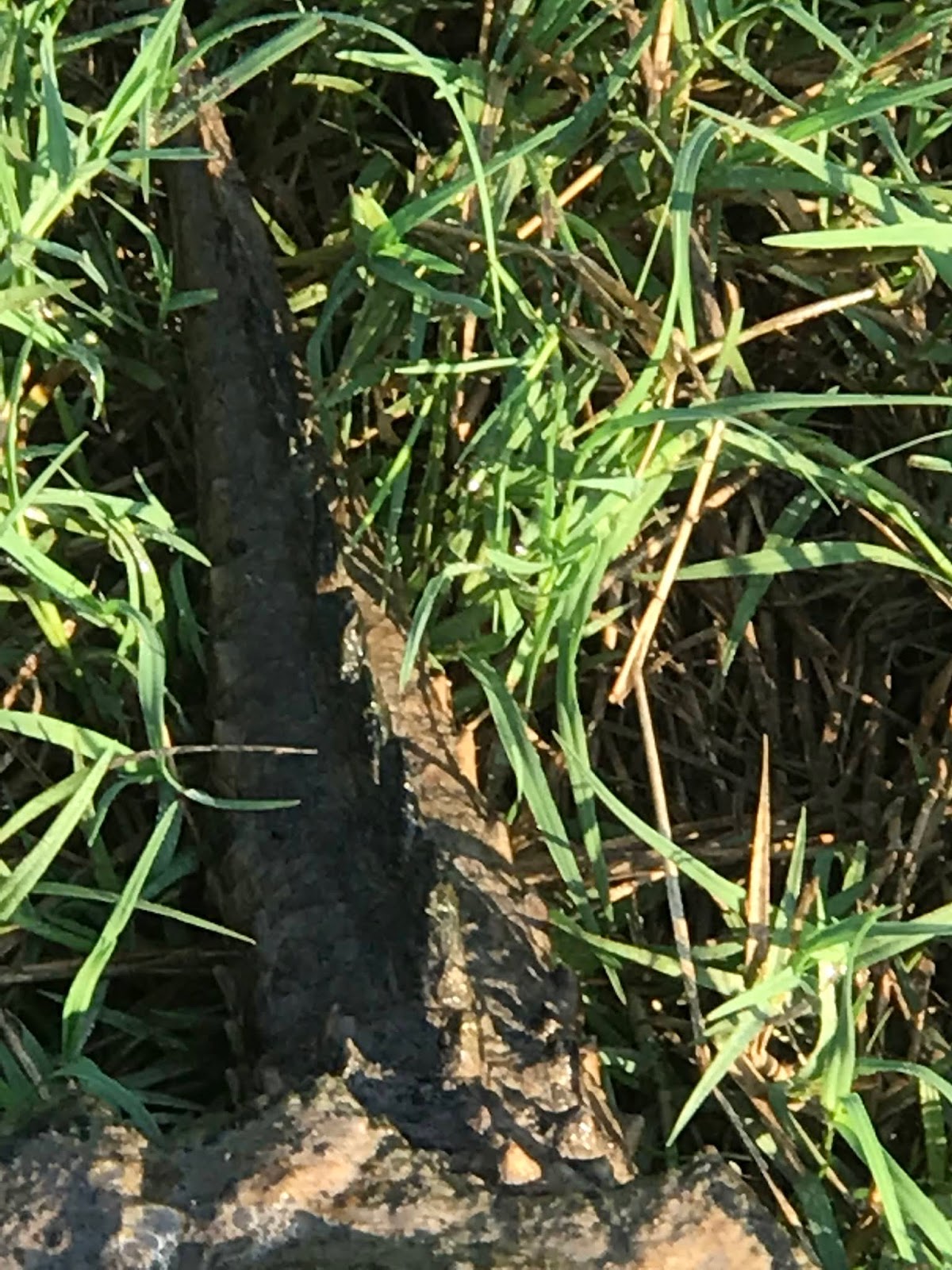
Yesterday as I was out checking cattle I came across this old boy making his way across the pasture.  We had good rains a few days ago and there is lots of water so, he wasn't far from the next pool.  I'm sure he was out exploring, shopping for a new neighborhood.  This is a Common Snapping Turtle (Chelydra serpentina).  They are found pretty much everywhere east of the Rocky Mountains.  This one probably weighed around 12-15 lbs but they can get much larger.

He was fairly calm as I moved around him taking his photograph -- almost as if he was posing.  He was obviously wary, but I suspect he was "King" of the last waterhole in which he lived and felt like he could take on anyone or, anything. 

When I was a kid we sometimes would get to go fishing in a farm pond on one of several places near where my Dad was raised.  There were lots of turtles, including this bad boy's bigger cousin, the Alligator Snapping Turtle.  They could be vicious.  They showed little fear either and would open their vice-like jaws wide while hissing at you.  They put plenty of fear in this kid who was told if one bit me they wouldn't let go until it thundered.

When I look at the photos I am reminded of the creatures in Jurassic Park the movie and its sequels.  The Snapping Turtle truly looks like a dinosaur with its protective shell and spiny tail.  Just imagine a larger version of it coming after you.

Turtle eggs were a prized source of food for many of the tribes native to the southeastern United States.  The adults were the primary ingredient in turtle soup.  They are not threatened or, endangered but, if you like turtle soup, be aware that since they often inhabit stagnant pools and will eat virtually anything -- plant or, animal -- they tend to concentrate any toxins that may be in the water and eating too much turtle might not be a particularly healthy endeavor for that reason.

As any of you who read this Blog on a regular basis have probably figured out by now, I enjoy the outdoors and the wild plants and animals found there.  Unlike many who think agriculture and wild places can't co-exist, I believe they are complementary.  We need to re-think some farming practices such as mono-cropping, but for the most part, nature is resilient and when we do things correctly in food production, wildlife abounds alongside our domesticated animals.  The grass you see that turtle making his way across is food for the cattle and also acts as a filter for the water running into a nearby creek.  The runoff from this pasture is virtually clear water whereas forested areas nearby, which have little ground cover, produce muddied water full of soil and debris.  Ranching is good for the land if for no other reason than that cover of grass which cleans and purifies the water before it goes into the reservoirs from which we obtain our drinking water.  Besides, who wouldn't prefer a steak to turtle soup?

Saturday, August 24, 2019

Snowy Egret


In the shallows,
Statue still,
Poised to strike
Some unwary victim
Soon to be victual.

Pristine white feathers
Against the sky,
Deceive the eye
Of passing creatures
Down below.

Patient hunter,
Winged beauty,
Graceful flyer,
Eye catcher,
Peaceful elegance.

The snowy egret was once threatened for its beautiful plumage which brought double the price of gold in the 1880's.  The feathers were highly prized to grace the hats of the ladies.  They have recovered and are common today.  Read about them here.  The one in the photo above was visiting one of ponds on our land.  Without the development of water sources such as this one, the opportunities to feed would be greatly diminished for many wading species such as this snowy egret.  Ranching has and continues to serve an important role in conserving open spaces for wildlife throughout our country.

Monday, July 1, 2019

Fallacies, Farming and Food

There seems to be a growing movement of young people -- well, not all of them are young -- who are becoming "experts" about agriculture.  They scour the Internet for information on everything from the evils of industrial agriculture to the destruction of our health with processed flour.  Their certainty of "right and wrong" is based on, "I read it, therefore it is correct," without ever questioning the source of the information.

Along with this desire to become "experts" on subject matter which requires a lifetime to master, they need to develop a little wisdom.  We have tried to instill in our children and to a lesser extent, our grandchildren, the discipline of questioning what they read.  Just because someone has a PhD after their name, or is considered an expert in their field, doesn't mean they don't have an agenda driven by less-than-pure motives.  It is important to question and dig deeper.

There is no doubt that there are better ways of doing things.  In my lifetime I have observed significant changes in agriculture that are more focused on conservation while still increasing production.  While still in college I spent some time working for an irrigation company converting sprinklers from high-pressure "rainbird" type sprinkler heads to low-pressure emitters on "drops" that used less water, less energy and placed the water closer to the plant so there was less evaporation loss.  Many small grains farmers have switched to minimum, or no-till planting and cultivation systems that leave the land almost undisturbed.  It increases the amount of organic matter in the soil, reduces loss to water and wind erosion and saves energy in the farming operations.

Some farms have switched to "strip-till" methods where they alternate crops in narrow bands.  It is a method to help reduce insect infestations because of the variation in plant species.  It also changes the soil health by utilizing nitrogen-fixing plants alongside nitrogen-depleting plants.

We see more and more farms that utilize grasses to slow runoff from fields and create "filter zones" to catch silt before it enters a stream or river.  Streams are bordered with trees and grasses rather than the crops being planted right up to their margin.  Such practices protect our water supply and provide habitat for wildlife.

Precision farming methods now vary fertilizer application, seed population rates and therefore, plant densities across a field based on the needs and capabilities of the ever-varying soils.  Such methods reduce soil depletion while also reducing, or eliminating fertilizer from being carried off the field by runoff.  It allows the maximization of production with the optimization of inputs.

Yet, the cry is louder each year that farming is "bad" and we need to re-think everything we do in agriculture.  I wish more people had the opportunity to actually spend time with farmers and ranchers to see what they are doing to protect our environment while growing more food, more efficiently, so those very people who complain will have plenty of inexpensive food to eat.

There is always room for improvement, but there is much that has been done and many who are working diligently to make those improvements happen.

Friday, July 25, 2008

We Can Do Better

We frequently see the debate between “environmentalists” and the rest of us as framed in an “us” vs. “them” manner. Business people feel that the environmental movement is nothing but a roadblock to progress. People in developing countries see environmental groups preventing them from experiencing the luxuries of the west because they hinder the utilization of the natural resources at hand.

Environmental groups often carry names like “Friends of the Earth” or “Save the Wildlife.” Those types of names carry with them a stigma that immediately sets on edge the typical businessman.

What if the debate became a completely economic one?

There is within the economic community the idea that when external costs are internalized into the price of a good or service, the decision to allocate resources to that good or service often changes. An example of internalizing these externalities would be the impact of a uranium mine on the Navajo Reservation. In order to avoid the potential complexities of the decision, let’s limit it to one possible issue – or, external cost -- the impact of the mining activity on the water supply of a community.

Suppose that the mine is located within the watershed of a Navajo community. To fully understand the cost to develop the mine, the potential pollution of the community’s water supply must be examined. Such examination would need to include preventative measures and possible remediation in the event of contamination. It also would need to look at long-term effects to wildlife residing in the watershed. Wildlife might provide hunting lease income to the reservation. It might also be of significant cultural value that would be difficult to price. It might affect tourist income from photography or viewing. It might impact local artisans who utilize specific clays located within the watershed.

With the exception of preventing and remediating potential contamination, none of the impacts mentioned are direct costs to the mine owner/operator. They are however, external costs to the community of locating the mine in their watershed.

How does one determine the value of natural resources? We can estimate the value of mineral deposits. We can value land based on the transactional market for similar properties. But, how do we value the less obvious things such as: filtering the water supply, tourism, hunting and fishing, recreation, moderating effects on climate, flood protection, erosion control and other items about which we don’t currently understand?

Hopefully in the near future, we will see attention paid to such values. Such things must be part of an overall land use plan before disruptive activities are begun. We need oil, natural gas, wind energy, solar energy, coal and we need minerals that can only be obtained through extractive activities. Surely we have learned enough of the complex interactions of the environment to begin to make sound evaluations of our activities in a broader sense. We must learn to utilize our resources without destroying our surroundings. Let’s drill – but let’s do so in an environmentally informed manner. Let’s build windmills for electrical generation – but let’s situate them in a manner that retains the benefits of our wild lands. Let’s learn from the unintended consequences of our past mistakes – such as ruined lakes and streams from coal mining or oil and gas extraction. We can do better.

Friday, August 24, 2007

A New Blog

I have undertaken a new blog. You will find it at Common Sense Agriculture, Conservation and Energy. Come on over and check it out.
Google