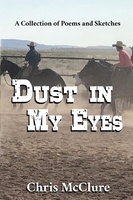
Check out my book!

Dust In My Eyes
McClure, Christopher P.

Thursday, May 21, 2026

 New Pathways

When the path becomes worn

And the ruts become deep

Life becomes dull

And the soul goes to sleep


That's when it's time

To strike out anew

To carve your own way

To experiences new.


Wednesday, May 20, 2026

 Another One Down

If a tree falls in the woods and there is no one to hear it, does it make a sound?  I can attest that if it is nearby when you are walking it definitely makes a sound.

The other day we were taking a walk down the driveway and heard a loud "crack" nearby.  There was a light breeze, but nothing too strong.  We could see nearby a tree that was just beginning to settle against other trees, and I made the comment that we might need to watch out that it was likely to come to the ground.  It did.  Slowly at first.  Settling against the upper branches of surrounding trees.  Then, with a final crash it came to the ground about ten yards from where we stood.

The photo below doesn't do it justice for size.  Apparently, the top had broken off previously.  I had seen it lying in the woods but hadn't yet had time to drag it out.  The broken end is about 8 inches in diameter.  I don't know how long it is, but it will take some time to cut up.

It being dead, I knew it would eventually come down, but I wasn't expecting it to do so as I walked by.  It makes you stop and think about how disaster can sneak up on you if you aren't paying attention.  The fact that it was dead was a warning sign.  I simply ignored it.

We need to be aware of the warning signs around us.  If we don't tend to the business of keeping things in order, disaster can occur with surprising rapidity.  That applies to our families, our homes, our businesses and our country.  Plenty of warning signs out there.  A little maintenance can fix much of what is wrong but until that happens, we'd better be paying attention.


Tuesday, May 19, 2026

 Designed Fit

Have you ever noticed that pollinator species tend to choose specific flowers?  I am certainly no expert on the subject, yet it seems to me that species such as Hummingbirds, Bees and Butterflies are very discriminatory in the flowers they choose to land on.

We have different types of flowers, most of which are either native species, or closely related to native species, in our flower beds.  The Ruby-throated Hummingbirds like the Texas Lantana right now, but we know from past observations that they will go to the Texas Sage equally when they are in bloom.  However, they seem to ignore the Gaillardia and the Coneflowers.  Likewise, we see certain species of butterflies that prefer the opposite and still others that only visit other species of flowers which are in the meadow.

Design is important.  I'm referring to the specific shape, size and function of various body parts of these creatures.  The long beak of the Hummingbird is well-suited to reaching into trumpet-shaped flowers whereas the butterflies appear to be more suited to flowers that don't require reaching into a deep well to access the food supply.

Everything we see or build is designed with a specific use in mind.  Whether it be a rocking chair on the front porch or a military aircraft, design is based on use and functionality.

Why do humans sometimes think they should ignore their own design and attempt to be what they are not?  It puzzles me.  It's their choice, but still, it puzzles me.  We don't see that in nature.

Below is a Horace's Duskywing (Erynnis horatius) perched on a domesticated Gaillardia.  Their caterpillar stage is especially fond of oak trees of which we have many.


Monday, May 18, 2026

 In Disguise

There are many who claim that during the Cold War, the Soviet Union placed "sleeper agents" among U.S. citizens that were able to blend in and appear completely non-threatening to the general population and who were unidentifiable by government agencies.  Their role was to blend in, hidden, until needed for some type of covert, or overt action against the country.  They quietly lived what appeared to be a normal life until or unless, activated.

It was the ultimate disguise.  Your best friend might be a foreign agent, and you would never know it.

Some might claim the same is happening today although the powers behind such actions are different.  Your next-door neighbor might not be as benign as they appear.

I have no desire to stir up fear, merely to create an illustration of behavior that was developed by mimicking behaviors that are common in nature.  The cuckoo lays its eggs in the nests of other birds, so it doesn't have to rear the young.  Other behaviors are more overtly parasitic in nature where one species lives directly off of another.

Dasymutilla bioculata, in the photograph below, is commonly known as a Velvet Ant.  This one was passing near our fire pit the other night and I was able to take the picture.  Velvet Ants are actually a parasitic wasp.  Notice that its coloration is similar to some of the paper wasps which are common here.  They lay their eggs inside the cocoons of other wasps.  Upon hatching they frequently kill their hosts.  Their stings are extremely painful.


Saturday, May 16, 2026

 Climbing

I spent a few years believing that I wanted to climb the company ladder.  I made it a fair way up before I learned that it wasn't much fun.  The politics become fierce and the dirty tricks come out.  Too often those rewarded were the least deserving based on merit but were masterful at manipulation and foul play.

Peter Drucker once said something like, "a person will climb to the level of their incompetence."  I think that is very true.  We are each designed with certain gifts and abilities that make us uniquely suited for specific roles.  Those who find themselves outside those roles due to blind ambition or poor choices will reach a point beyond which they can't go.  Others simply reach a point beyond their personal talents and abilities.

One of the most glaring examples that I have seen through the years is to take an outstanding salesman and put him into management.  Some do well in the role, but most are average at best.  Both sales and management suffer due to the promotion.

Pride and greed often get in the way of good decisions.  Pride in the form of "look at me and how far I've come!"  Greed in the form of seeking a higher level of income in a role that makes you miserable.  The key is to find what you are made for and do it to the best of your ability.  Bloom where you are.

The Climbing Prairie Rose (Rosa setigera) is found from Texas to Wisconsin and all the way east to the coast.  The beauty pictured below was in a hidden area of our small acreage.


Friday, May 15, 2026

 In The Shadows

Tucked up next to our house in the most shaded spot possible is a plant growing in compacted soil.  As it first made its appearance earlier this year, it looked almost like a coarse-leaved grass of some kind.  With growth it became clear that it was probably some kind of Lily.  It finally bloomed this week and even in its most showy state still seemed somewhat hidden in the shadows.

There are a lot of people like that plant.  They face tough circumstances and throughout their life quietly remain in the shadows doing their job where they not only survive but thrive.  They do what they do well despite the adversity they face.

I admire someone like that.  They have found a niche in which to build their lives, and they work hard to make it the best life possible.  Often, the next generation, their children, succeed in unexpected ways because they were taught the values that drove their parents to excellence despite their circumstances.  They deserve our respect and they deserve recognition for what they have done.

Many of my classmates in school came from such circumstances.  Their families worked hard through struggles that others didn't face.  Many of those classmates have gone on to have very successful careers.  Several were the first generation to go to college.  Others own their own businesses.  They have fought to succeed and have done well.  I admire them.

Below is a photo of the orange daylily (Hemerocallis fulva) growing in the shadows near our home.  It thrives despite its circumstances and when you stop and take notice you see its glory.


Thursday, May 14, 2026

 Invasion With Benefits

There are many invasive plant, insect and animal species that have found their way to our country.  Most of them exploit a niche that may be occupied by other species which may be unable to resist the invader.  Some of them are harmful and some less so.  Some may be beneficial.

It is wise to be cautious of uninvited guests.  That's why the government has inspection services that seek to limit or prevent the entry of plants, animals and other species that might be harmful.

We are very careful what plants we bring onto our small piece of Texas.  We prefer those which are native and try to avoid those that may proliferate beyond our ability to control them.  Over time we hope to identify all of the different species currently on our land and eliminate those which are invasive and destructive.  It is only common sense that we protect our home.

One of the invasive species that we have found is the Asiatic Dayflower (Commelina communis).  It blooms for only one day each year.  It originated in Asia but has spread to many areas throughout the world.  In China it is used as a medicinal herb and for making certain dyes.  It is sometimes found as an ornamental.  Recent research indicates it may have beneficial properties for soil remediation where it is found to remove copper, lead, zinc and cadmium from the soil and does well on reclaimed mining sites.


Wednesday, May 13, 2026

 Contentment

Jake is the faithful guardian of our place.  He was found by the side of the road as an abandoned puppy, rescued and through a series of connections, ended up as part of our household.  He is, and has always been, an outside dog.  He generally refuses to come in when invited.

Until we moved to our present home, Jake always had a fenced yard in which he stayed.  Until a couple of years ago he had an older companion which kept him company and, in many ways, raised him.  Due to age and infirmities, she did not make the last couple of moves.  Before bringing Jake to his new home, we constructed a fenced area specifically for him.  Our assumption was that he would be more comfortable in an enclosed area since that is the way he had always lived.  That assumption was incorrect.

Jake became an escape artist.  It became apparent that we would never be able to confine him again, so with admonitions to confine himself to our property (yeah, like that was going to happen) we allowed him to roam.  We are far enough from busy roads that we felt the risk of being hit by an unwary driver was low and that he had the age and maturity to remain close.

Jake did introduce himself to our neighbors and was especially welcomed by the children.  He seems to have a way with young humans and is like a big teddy bear.  Our grandchildren all seem to be happy to see him and my father-in-law, who is in his upper 80's always asks about him since Jake stayed with him for a brief while during our transition to this place.

He seems content.  He often lays on the front porch surveying his domain and protecting it from wandering rabbits or other small creatures that stray into his vision.  I don't think he could catch one and am somewhat certain he doesn't really try; he just lets them know that they are in his territory and he is the boss.

Contentment is something that most of the human race never finds.  Learning to live in the moment and know that all is well is rare.  I think we all need to learn to take life a little more like Jake.


Tuesday, May 12, 2026

 Homemade

Do you ever think about how we learned to do so many things?  I spent some time the other day researching how to make paper.  It stemmed from reading a book in which one of the characters made their own paper and ink to draw and illustrate plants.  I will likely attempt it at some point, but it looks like a lot of work.

I wonder if early paper was conceived by watching wasps build their nests.  There are over 1100 species of paper wasps around the world, so it is quite possible that primitive man sought to reproduce the material that comprised wasp nests.

Rock, wood and vellum (animal skin or membrane) were likely the first writing or drawing surfaces for primitive artists and calligraphers.  Around 3,000 BC the Egyptians developed a process of making paper from the papyrus plant.  It was commonly used for thousands of years until replaced by thinner, smoother sheets made from milled plant and wood fibers in a process thought to have been developed in the Han Dynasty of early China around 20-220 AD.  Because it provided a better writing surface it spread westward and became widely adopted by the Islamic world by the 8th Century.  It was another 300 years before it spread to Europe where it replaced the use of animal skins.

Papermaking continues to improve even today with the addition of plastics as well as more advanced fiber processing.  Adding a wax coating to paper allows its use for drinking cups or straws that are completely biodegradable, unlike plastic based coatings.

Paper wasps construct their nests with fibers pulled from dead wood and other dried, fibrous plant material.  The fibers are chewed and mixed with saliva before being pasted into the familiar umbrella-shaped nests filled with chambers for raising the next generation.

The wasp in the photo is stripping wood fiber from some oak firewood.


Monday, May 11, 2026

 Mid-Air Refueling

Hummingbirds are amazing creatures.  We planted Texas Lantana and Texas Sage specifically to attract them and the butterflies.  A couple of the Lantanas are in beds which front our porch where we have a couple of rocking chairs that allow us to enjoy the beautiful weather we have been experiencing.  We sometimes sit there watching birds and using the Merlin app on our phones to help us identify them by their calls.  We also hope for the tiniest of winged visitors to helicopter in for a quick sip of nectar from the flowers.

The Ruby Throated Hummingbird (Archilochus colubris) is the most common out of the 363 species found across the Americas. (For a great list of 10 Interesting facts, click here.)  I was fortunate a couple of days ago to have phone camera in hand when one made a brief re-fueling stop.  The buzz of wings sounded like a giant bumblebee as the tiny, winged blur dropped in for his snack.

How can such a high-energy consumer drink enough nectar in tiny sips to keep its body fueled?  It is no wonder they always seem to be in a hurry, dashing from flower to flower for quick a caloric boost before moving on.  Unlike bees and other pollinators, they don't lite upon the flowers but delicately partake of their meal without touching other than with their beak and tongue.

I wonder if engineers got the idea for mid-air refueling from watching hummingbirds.


Saturday, May 9, 2026

 Preconceptions

As we sat on the patio yesterday during a break from our yardwork, I noticed what I thought was a beetle land on one of the tomato plants.  I watched him a moment then decided to take his picture to see if I could identify what he was.  He was rather unique looking, but I feared he would start munching on the leaves and if that was the case he would find his life span shortened significantly.

It was identified by iNaturalist as a Black Firefly (Lucidota atra).  That gave me pause because fireflies are supposed to fly at night -- hence the name.  It turns out this particular species is diurnal (likes the daylight).  It preys on soft-bodied invertebrates such as snails and slugs.  That makes him one of the good guys.

I have to admit that I judged him prematurely.  I thought he was there to attack the tomatoes, and I was prepared to take immediate action.  We do that about a lot of things -- prejudge.  It is because our crazy minds are wired to defend against things we have been conditioned to see as potential danger.  These preconceptions can be useful but can also cause behavior that is harmful.  That Firefly was a beneficial that would have fallen to my preconceptions had I not paused to learn a little more about it.

One of the things that sets humans apart from animals is the ability to override the wiring in our DNA and use reason.  That ability to reason opens doors of understanding.  This world needs a lot more understanding.


Friday, May 8, 2026

 Confusions From Conclusions

Sometimes the "Ah ha" moments shouldn't be.  Jumping to conclusions with incomplete information can lead us down paths that only add to the confusion already sloshing away in the chemical solutions of our minds.  A small piece of information can ignite those synaptic connections in a way that could best be described as a short-circuit.

Using the iNaturalist app on my phone I identified the flower pictured below as Carolina desert-chicory (Pyrrhopappus carolinianus) and given the name, jumped to the conclusion that I had finally discovered what Chicory looked like.  Chicory has been a common substitute or, addition to, coffee for many years.  In my mind I associated it with the Deep South -- especially during the Civil War when Naval Blockades limited the supply of coffee to southern ports.  So, seeing the "Carolina" in the name as well as the word "chicory" I had an "ah ha" moment that led me to believe we had the coffee substitute growing on our place.  I was wrong.

When I dug deeper and did a little research on the plant, I found that, although in the same Family, Asteracea, it was not the same plant as is used as a coffee substitute.  I did learn that it is also called the Texas Dandelion and is common on roadsides throughout the state.  Hmmm...maybe the leaves are edible like those of the true Dandelion.  Nope, wrong again.

Our brains are amazing and work in ways beyond our understanding.  Unlike the massive AI data centers currently under construction, they utilize only a small amount of energy to gather, organize, store and comprehend vast amounts of information.  But, just like a computer program, the saying, "garbage in, garbage out" is also true.  That amazing organ in our skull can make mistakes but it also holds the power to limit those mistakes and to correct them.

We believe many things that are simply not correct.  Those beliefs stem from the information that we feed into that amazing organ which resides between our ears.  If the information is incorrect, or incomplete, we draw wrong conclusions and what we think we know is really the confusion caused by incomplete or incorrect information.

In today's world of social media, the propagandists understand and exploit that weakness.  We all need to learn to dig a little deeper.


Thursday, May 7, 2026

 On The Shelf

Being put on the shelf can be a good thing or it can be a signal that utility has diminished.

We have all heard of "Top Shelf" items such as a valuable Crystal Bowl, or for some, a high-dollar bottle of Bourbon.  It's also where one might place objects they wish to admire such as photos of loved ones.  Maybe it's an old Cream Pitcher that a great-grandmother used which once held cream separated by her own hands that ended up on great-grandfather's oatmeal.  Whatever it might be, it is held in a place of honor.

We have also heard the term used in a less honoring way such as when one is "put on the shelf" which connotes that they are no longer needed for service.  This happens to older employees who are given a watch and a plaque as they are retired.  It is a symbolic way of telling them they are no longer needed.

Life is a series of cycles, all of which fit into the larger cycle of birth, growth, death and rebirth.  In nature, death is followed by resurrection as the nutrients are broken down and then utilized by plants, animals, insects and other living things such as fungi.  If your view of life is simply that of the natural cycles, then that is what you have to look forward to.  My view is that is what will happen to our physical body and if you have never experienced a Spiritual Birth, that will be the end.

Stereum fasciatum is a fungus that colonizes dead trees.  It is a "shelf fungus" and clearly signals the end as it breaks down the wood into its component nutrients.


Wednesday, May 6, 2026

 Aggressive Home Invaders

Yesterday was tree trimming day around our place.  We have several large Sweetgum trees that needed some shaping up.  One of them contained a birdhouse which I had not seen any birds approach.

We've only been here since mid-January and things like the undesirable branches and the birdhouse were left by our predecessor for the new owners to handle.  There are a couple of other birdhouses, one of which was featured in a previous post with a nest of baby Eastern Bluebirds in it.  No birds would come near the birdhouse hanging in the Sweetgum tree.

I decided that since the birds didn't like the birdhouse in question, I would remove it from its prominent place.  After trimming limbs which had grown near it, I unhooked it from its perch and let it drop to the ground.  I quickly found out why the birds avoided it as a number of red paper wasps came boiling out of it in search of something to blame for their short drop and abrupt stop.

After batting the most persistent of them away with my sweaty cap, they learned to keep their distance from me but continued to remain in the neighborhood.  Wasp stings are not something I desire and when younger, would react somewhat severely to them.  Needless to say, I was wary of the tiny, winged warriors as I completed my task of trimming the tree.

In recent years there have been numerous stories of home invaders in the news.  I find it disturbing that someone would think it is an acceptable thing to do.  As I think about it though, I realize it is simply animal behavior.

In nature it is not uncommon for animals to occupy burrows created by other animals (think Rattlesnake in a Prairie Dog hole).  Animals will slip into a temporarily unoccupied den and then defend it by force.  In this world of increasingly animal-like behavior by humans I suppose it was only a matter of time that such things as home invasion and adverse occupation would occur.

Below are a couple of photos of the birdhouse in question.  The first shows the entire house while in the second you can see the dislodged Paper Wasp nest resting on the bottom.


Tuesday, May 5, 2026

Fear vs. Knowledge

We sometimes fear things that we know to be harmful.  Through past experiences or, perhaps, through study, we learn -- we expand our knowledge -- regarding that thing and acknowledge it is potentially harmful.  Knowledge helps us to know how best to respond.

There are many things, however, that we fear due to ignorance or misperception.  We are wired (my term for our genetic inheritance) for fight or flight.  It might be as simple as public speaking or as complex as using a computer for the first time.  In the case of speaking, it is fear of appearing foolish or of failing to make a positive impression.  In the case of the computer, it is fear of breaking it.

One of the things most people grow up with is a fear of snakes.  That fear is societally programmed into us and likely wired into us.  Some snakes can be deadly and if you don't know what kind of snake you are dealing with it is best to err on the side of caution.

Snakes play a beneficial role in nature.  They are especially adept at managing the population of many pests.  Rodents are a primary source of sustenance for many species whereas insects play a significant role in the diet of others.  Even those species of snakes which are potentially deadly due to their venom can play an important role if they are respected and given space.

My grandfather's barn had a workshop just inside the main door, and Grandpa always threw junk scrap metal in one corner at the end of his workbench.  It was on an outside wall and in time, a rattlesnake made that scrap pile its home.  I knew about it as long as I can remember.  Until I was old enough to understand the danger, Grandpa wouldn't let me go into the shop alone.

He didn't have any rodents in the shop thanks to that snake.

After Grandpa died and we were cleaning his shop that snake played an interesting role in a story I will relate at a later time.

Learn about snakes.  They are interesting creatures and provide an important service.

Below is a Western Rat Snake (Pantherophis obsoletus) pictured both coming and going.  He was resident in a small woodpile we moved.  I don't think he was happy that we discovered his hiding place but there are plenty of others to which he can relocate.  Rat Snakes are interesting in that they often winter in shared dens with other species of snakes -- especially Copperheads and Timber Rattlers which are both poisonous.


Monday, May 4, 2026

 Gone Wild

I think sometimes that we have become too domesticated.  People don't know where food comes from, they live more in fear than in freedom and they have lost the ability to survive and thrive in this world gone mad.  Skills for survival, many of which are genetically programmed into us, have been suppressed and are slowly being bred out of many genetic lines through the natural selection process which draws individuals of similar temperament to each other.

A couple of days ago we stumbled across some roses growing wild in an off-the-path part of our place.  We were astounded at their beauty.  They spread over a significant area and were in full bloom.

There are many beautiful varieties of roses that are grown domestically and there are many people who deeply enjoy cultivating various special varieties of roses.  To me they seem a little unnatural -- too domesticated.  Finding the wild variety in an unexpected place reminded me that it is often the untamed that exhibits true beauty.


Saturday, May 2, 2026

 Is It a Weed?

Green Antelope Horn Milkweed (Asclepias viridis) is an important plant for the Monarch Butterfly.  The Monarchs reproduce in the southern U.S. in late summer when the plant is tough.  The problem is that they prefer tender leaves which provide food for the caterpillar stage.

Many ranchers see the Milkweed as just that -- a weed.  It is often targeted along with other weeds that compete with the grasses for grazing.  In many areas, although the Antelope Horn is a perennial, their presence is declining due to the use of herbicides for the control of all non-grass species growing in pastures.

For those ranchers who utilize mechanical means, such as mowing to control pasture weeds, the Antelope Horn and Monarchs can benefit.  Mow in July so that there will be new, fresh growth of the Antelope Horn in August when the Monarchs arrive and are looking for places to reproduce.

Any plant can be considered a weed.  The definition of a weed is any plant growing where it is not wanted.  Competition between plants for limited resources is a critical issue for ranches -- especially during drought conditions.

The way ranchers choose to control weeds is generally an economic decision.  Often, chemical means are the most effective and the most cost effective.  Many weeds are a sign of overgrazing.  They colonize where the grasses have died due to drought and inadequate leaf cover -- not enough left standing.  Without the standing forage, the heat and drought conditions can kill the roots, creating bare areas.  When the rains come, forbs -- weeds mostly -- are the first plants to return.  Reducing weeds allows more grass to be produced.  It is something of a balancing act that requires careful attention to maintain soil health and a healthy balance of the plants growing.  Those factors then determine the level of grazing that can be healthily maintained.

When you add the desire to retain habitat for species such as the Monarch Butterflies, the equation becomes more complex.  Despite the bad reputation they often receive, most ranchers wish to see nature thrive and work to maintain healthy land and pastures.  For those who have areas where the Antelope Horn is established, they can use mechanical means only for weed control while utilizing the more effective chemical means in places that don't contain critical species.  Summer mowing would open the canopy for late season growth while stimulating re-growth of the milkweed prior to the needs of the butterflies.


Friday, May 1, 2026

 Perspective

According to Merriam Webster the first definition of "perspective" is "a mental view or prospect."  It recognizes that our mind shapes what we see.

The obvious shaping by our mind is the simple interpretation of the light reflected from an object that creates an image on our retina that is then transmitted to the brain by the optical nerve.  The quality of that image is a function of the shape of the lens, the eyeball which determines the focal length and the healthiness of the tissue over which that image is passed.  It is purely physical in nature.  But there is also a mental aspect to perception.  The mental part of interpreting what we see is shaped by experience and knowledge.  It is something I might call positional perspective.

Positional perspective might simply refer to where we are standing.  If I am in front of an object and you are to the side of that same object, we might see very different shapes.  It's like the old tale of the blind men touching an elephant -- each at a different point -- and each describing it very differently.  We do the same thing mentally when we view something.

Sometimes our view is of an idea or concept.

City dwellers see things very differently than those who live in sparsely populated areas.  The problems that face those living in a crowded environment are not the same as those faced by rural populations.  Their perspectives of what are the most pressing problems vary widely.  Even when they recognize each other's challenges, they often perceive very different solutions. Their environment and experiences shape their view or, perspective.

Much of the division in our country is due to this issue of perspective.  Until we learn to "walk in the other guy's shoes" occasionally, we will not solve the problems that we face as a nation.  Understanding comes with experience and knowledge.  If we feed ourselves the same thing every day in the news we consume, the books we read or the people we listen to, our understanding of other perspectives is not likely to occur.  We all need to spend time with those who are not like us -- whatever "us" happens to be.


Google